About Me

My photo
Early childhood education has been my life for over 40 years. I have taught all age groups from infants to 5-year-olds. I was a director for five years in the 1980s, but I returned to the classroom 22 years ago. My passion is watching the ways children explore and discover their world. In the classroom, everything starts with the reciprocal relationships between adults and children and between the children themselves. With that in mind, I plan and set up activities. But that is just the beginning. What actually happens is a flow that includes my efforts to invite, respond and support children's interface with those activities and with others in the room. Oh yeh, and along the way, the children change the activities to suit their own inventiveness and creativity. Now the processes become reciprocal with the children doing the inviting, responding and supporting. Young children are the best learners and teachers. I am truly fortunate to be a part of their journey.

Saturday, February 27, 2016

Tubes and cardboard dividers

 Last week I wrote about cardboard dividers and a new type of play that emerged from the setup.

I left the cardboard divider up a second week, but I added three different tubes to the construction. First, I embedded a cardboard tube horizontally through the two walls on one side of the divider.  The cardboard tube reached over into the second table.  Second, I attached a clear plastic tube through the two walls on the same side of the divider as the cardboard tube.  The clear plastic tube was set on an incline so it would empty into one of the slots cut in the cardboard tube.
Third, I secured a white PVC tube through the divider on the other side of the installation.  That tube was also set on an incline and emptied back into the table into a corner cubicle on that same side.

Last week, there was a lot of play through the windows.  There was still some of that play, but children definitely changed the focus of their explorations to the tubes. 

The tubes, much like the windows, connected children in play across the cardboard walls.  Some of the play was as simple as filling your friend's container. 
Or was it so simple?  For this to work, there had to be ongoing coordination and communication. 

One of the big surprises for me was how children combined the tubes and windows in their operations.  A child in the video below figured out that he could insert a jello mold into the window so when his friend poured corn down the white tube, it helped fill the container.  In the video, watch their joint endeavor.


Filling the jello mold from Thomas Bedard on Vimeo.

The child pouring corn into the tube seemed to keep checking every time he would send some corn down.  These three-year-old children definitely worked together, but in a very complicated dance.

Here is another example of how the children modifyied the apparatus by using both a tube and a window. The children in the video figured out how to wedge a dust pan at the end of the clear plastic tube by using the window.  


Dust pan modification from Thomas Bedard on Vimeo.

As you can tell, they were very pleased with themselves because they figured out how to divert the corn coming out of the clear plastic tube.  The thrill may have been magnified by the fact that the corn was bouncing wildly on the floor.

I have always thought of the sensory table as a blank canvas for me to build apparatuses that I invite the children to explore.  After seeing these two videos, I am now thinking that the children use the apparatuses I build as a blank canvas for their own creations.


Saturday, February 20, 2016

Cardboard dividers

The cardboard divider apparatus is one of the first apparatuses I built in my classroom 26 years ago.  Back then, I had a very small table and I wanted to divide up the space to cut down on squabbles over shovels and pails and such.  I first wrote about this apparatus more than five years ago.
I have subsequently written about it in one form or another six other times.  The most comprehensive summary was a post called ruminations on the cardboard divider.  I have written about this apparatus so much because it is simple to build and, at the same time, it creates a myriad of possibilities for the children to explore and author unique play experiences.

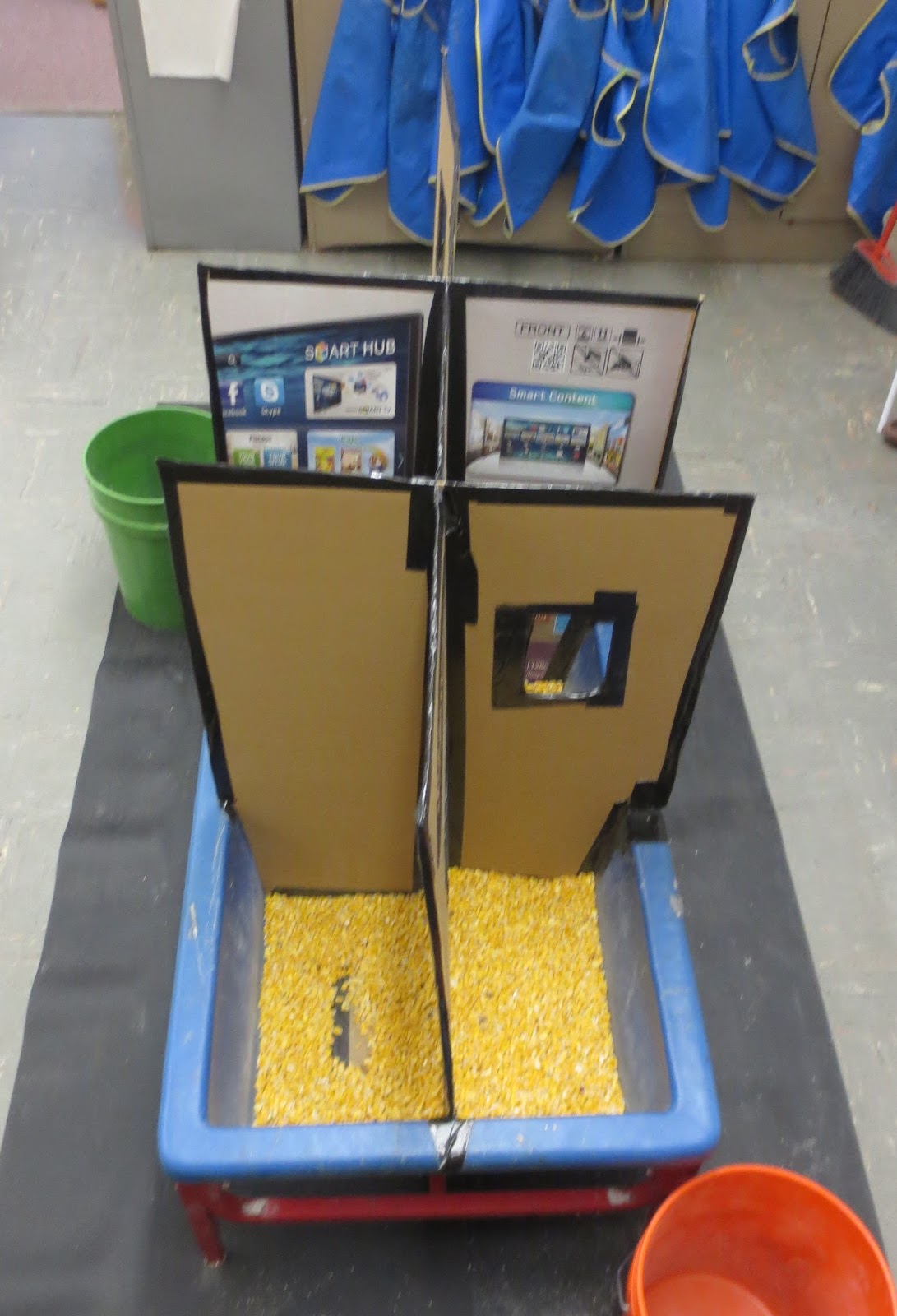
This year, I used a box from a large flat screen TV.  The box was big, which allowed me to cut one cardboard panel that was long enough to divide my two sensory tables lengthwise down the middle. 
I cut windows in the divider and then duct taped around them to lessen the prospect for paper cuts.  Someone I work with thought I had purposefully designed the windows to look cockeyed.  She liked the visual effect of the "crooked" windows.  The truth be told, I rarely measure; I just cut.  And the same goes for taping, too.

In addition to the one long panel, I had enough cardboard from the same box to make two flat cardboard panels for inserts to create spaces in the blue sensory table.  Here is a view from above.  It is easier to see how the inserted panels form the spaces across the width of the table.  These spaces are like little work cubicles.  And working in cubicles is a life skill, right?

Since I have written about this apparatus several times before,  I want to expound on only one type of social play that emerged this year that I have not seen before.  I don't know exactly what to call it but it involves ordering and making and paying for food through the windows.   What follows are three videos that illustrate this play.

In the first video, the girl looks through the window and asks the boy if he would like some food or something to eat.  The boy waits a long two seconds before he equivocally shakes his head "no."


Would you like to order something to eat? from Thomas Bedard on Vimeo.

I do not know why the boy doesn't accept the other child's invitation to play.  But that happens all the time in children's play.  And everybody just moves on to the next encounter.

In the second video, a boy is working feverishly filling his container.  He has already filled it to overflowing several times but there seems to be some urgency in his action.  When he is satisfied with his filling, he leans over the table and calls through the window to the other side: "More food."  I think he is letting someone know on the other side he has more food.  He moves to the adjacent cubicle and as he does he broadcasts that he needs an order.  As he moves to that adjacent space, the child in that space lets him in.  One more time he says he needs an order.  He proceeds to dump his container through the window saying: "More mac and cheese."


Mac and cheese from Thomas Bedard on Vimeo.

In this video even though one child is orchestrating the action, all the children are playing along.

In the third video, a mother is in the room playing with her daughter at the cardboard divider.  The daughter hands her corn through the window.  Her mother says she will pay her five dollars.  Mom reaches through the window and counts out five on her daughter's palm.

Five dollars from Thomas Bedard on Vimeo.

Without the cardboard divider, this sublime play episode with the mother and her daughter would never have happened.

Through observing children over the years at this apparatus, I know that children initiate new social interactions each and every time it is introduced.  What was different this time that spawned the "food through the window" play?  This play was widespread between other play partners and in other classes.  Why this play this year?  What experiences do the different children have with ordering or delivering food through windows?  What experiences in their life inform this play that make it meaningful to them?   

I have learned that I cannot always predict the scenarios that emerge in children's play.  And I cannot always know why those scenarios appear.  I suppose if I really wanted to know what to expect from children then I would have to teach differently.  But then I would just be fooling myself into thinking I can predict and know. 


Saturday, February 13, 2016

SOCIAL SKILLS

Once or twice a year, I put out Moon Sand.   When I put out Moon Sand, I like to set up a large wooden tray on which the children can work.  I start with two tables, the everyday blue table and the clear toddler table.
I place a large wooden tray on top of the toddler table.  To keep down the mess, I tape packing corners from an appliance box onto two sides and one end. 
The side that reaches over the blue table is left open.  That allows the children to easily move sand from the wooden tray into the blue table.

Besides the large wooden tray, I also set up a smaller wooden tray that spans the width of the blue table.
This picture highlights one of the salient features of Moon Sand.  It holds it shape so it can be molded.  That is also the reason I set up the trays with this type of sand because the sand forms take on more import when they sit above the table.  

In addition, the trays allow the children to work on a more comfortable level, much like the counter and workbench we use in the kitchen and workshop.  This more comfortable level, in turn, brings out the budding social skills of children.   For instance, in the picture above the children were making birthday cakes.  Once they were made, they decorated them.
And once they were decorated, the children had to decide which birthday cake was theirs.  And whose birthday was it anyway?  Watch.


Birthday cakes from Thomas Bedard on Vimeo.

Each child chose a birthday cake that was right in front of them  One child did change her mind because her friend pointed out that the figure on the other cake in front of her had longer hair.  Life would be so good if it were everybody's birthday and everybody was happy with the birthday cake they got.  (Did you notice no one picked the Ronald McDonald cake?)

Here is another example of those social skills in action.  Two boys were putting Moon Sand in a jello mold.  According to one of the boys, they cannot fill it to the top because they are making a little garage.  He qualified it a bit when he said they were making a little, big garage.  The other child keeps agreeing with him and adds: "...and then let's build a house."  


Building a garage from Thomas Bedard on Vimeo.

I have no idea how putting Moon Sand in a jello mold leads to making a garage.  But that is not important.  What is important is the natural way in which ideas flow back and forth in this give-and-take exchange between friends.

I write a lot about science and inquiry in relation to the apparatuses at the sensory table.  Just as important, though, are the opportunities they offer children to master the social skills such as negotiation and accommodation.  

On a lighter side, I want to leave you with a video with a touch of mirth that happened at the table this particular week.  In the video, the child in the orange tries to remove the Moon Sand that he has packed into a small plastic measuring cup.  He hits it on the tray.  But on the upswing of the second hit, it flies out.  It flies out right into the cup of the child on the opposite side of the table. (If you look closely at the setup picture for the video, you can see the Moon Sand in mid-flight over the other child's hand.)  When the child with the red cup looks for the Moon Sand, he can't find it and wonders where it went.  It happens so quickly that neither of the children notice what happened.  The child's face for whom the Moon Sand vanished is simply beguiling.  Enjoy.


Where did it go? from Thomas Bedard on Vimeo.

Saturday, February 6, 2016

CHILDREN TRANSFORMING AN APPARATUS

The past two weeks I have been writing about a concrete tube apparatus.  The apparatus is basically a big box with tubes embedded horizontally that is set over the sensory table.
The two big tubes on the bottom are tubes used as forms for pouring concrete posts.  The smaller tube is a piece of a carpet tube.

I kept this apparatus up for two weeks.  However, the second week I added a vertical element to the apparatus.  I embedded a rain gutter extender tube that went from the top of the box, through the inside of the box and out one side of the box.  The tube emptied into a five gallon pail next to the table.
I created a catchment around the top of the tube to capture the corn that missed the target as the children tried to pour the corn into the tube.  The catchment is a small box taped to the top of the big box with a hole cut in it to accommodate the gutter tube.
The purpose of the catchment was to keep down the mess.  This fellow was very accurate with his pouring, but as you can see, not everyone was.  By the way, the catchment also offered a lesson in volume as it filled up.

With this vertical addition, the children immediately started to go vertical on concrete tube apparatus.
The girl in the foreground balanced with one leg on the lip of the table while she held onto the box and kicked the gutter to to extract any pieces of corn stuck in the folds of the tube.  The child in the green plaid balanced on the edge of the window with his torso over the top of the box.  But why stop there?
What was it that drove this child to climb on top of the box?  How did he get down from the box? And what kind of teacher allowed this child to climb on top of the box in the first place?

Here is another two-year-old from another class who felt the need to climb on the apparatus.
This child spent a long time climbing.  This was surely full-body exploration.  He even used the concrete tubes for climbing.

And watch how he balanced on the lip of the table as he made his way around the apparatus to pour corn into the tube on the far side from where he started.


Climbing at the sensory table from Thomas Bedard on Vimeo.

You have just watched a significant transformation of the concrete tube apparatus brought to you by the children.  They transformed this sensory apparatus into a large muscle apparatus.  It was no longer just a place to scoop, pour and transport.  It also became a place to climb, balance, test muscle strength and take risks.  Those types of transformations happen all the time when children are agents of their own learning.

p.s.  When I give talks about building apparatus to change the sensory table, I have to caution participants that if you build vertically, the children will go as high as you build.  If you are not comfortable with children going high, only build to a height that matches your comfort level.  Don't be afraid to stretch a little, though. You might be surprised at what the children can do.


Saturday, January 30, 2016

MORE CONCRETE TUBE APPARATUS

In my last post, I hinted at a slight design flaw in the second concrete tube apparatus.  When the children poured corn into the slit cut at the top of the apparatus, it would fall and bounce off the concrete tubes through the big window onto the floor.

I never quite know what will happen when I turn over an apparatus to the children.  The children's explorations and investigations give an apparatus life.  It is only through watching them and seeing the consequences of their actions that I begin to understand how it works---and how they work.  I tolerate a lot of mess in the sensory area, but I am always looking for ways to minimize the spillage.  For that reason, I felt I needed to modify the apparatus so more corn would stay in the box instead of shooting out onto the floor.

The modification was fairly simple.  I embedded a third, smaller tube through the big box.  I taped the flaps of the big box to the tube so the corn would be directed into the tube and not the box.

Here is a view from the top.  I taped the flaps so the slot cut in the tube would catch the corn.  The corn that did not drop in the slot, stayed in the creases where the tape met the tube.  Eventually, someone would sweep the corn in the creases into the slot.

The new addition provided for another entry into play at the apparatus.  Adding more invitations, expands the explorations.  Adding more invitations also adds to more types of play, whether that is in the tubes, on top of the box, or in the box.

When I looked over my documentation of play at this apparatus, I was intrigued by how even a bulky apparatus like this fostered connections between children.  The apparatus created large spaces between and separating children so how could it possibly foster connections?


One of the ways the children connected was with a game of peek-a-boo through the tubes.

There was a more active way to connect through the tubes, also.  In the video below, one child scooped corn into the cement tube while the other one pushed it right back out with a long-handled plunger.


Tube connection from Thomas Bedard on Vimeo.

In a way, this felt like a dance.  They both used the actions of the other to create a scoop and push the corn one-step-two-step.  Interestingly, they were not using facial cues but physical and material cues.

Here is another example of this kind of connection.  Two children used their homemade plungers to joust in that space under the box.


Jousting from Thomas Bedard on Vimeo.

I would say this was more like play fighting.  The play fighting, though, is limited by the space under the box.  We usually think children make connections through facial and body cues.  Here, though, was another example of reading physical or material cues.

After looking at the documentation showing children connecting with each other at the Concrete Tube Apparatus, I wondered if the barriers created by an apparatus offer children safety to try out different ways of connecting. 

Of course, children do not need barriers to connect.  Sometime a loose part is all they need.  Here is a lovely video of one child helping another child fill the clear tube into which he has inserted his hand.  Watch the subtle looks and smiles as one helps the other.


Connection from Thomas Bedard on Vimeo.

To be sure, these were fleeting connections that may never happen again in the room.  That does not make then inconsequential.  Maybe by paying more attention to these moments of connections---even those across constructed barriers---we will see more.

What do you think?  Do barriers foster connections?  If so, why and how?  How do those connections differ from the ones create by reading facial and body cues?


Saturday, January 23, 2016

APPARATUS II WITH THE CONCRETE TUBES

Back at the beginning of December, I wrote a post about an apparatus I made using concrete forming tubes.  I created a gradient with these wide tubes by cutting them to three different lengths.  
On the gradient, I placed a long cardboard tube with various holes for the children to use in their operations.

Someone commented on the post and thanked me for giving her an idea for how to use the large concrete tubes that were left over from the recent renovation of her playground.  The comment got me thinking that there must be other ways to use the wide tubes.  I began to play with the orientation of the tubes in my mind (See the right hand column of the blog under orientations.).  For the original apparatus, the tubes stood vertically in the table.   What would happen if I decided to use the tubes horizontally?

I cut the longest tube to match the middle tube so I had two tubes that were 2.5 feet long.  I embedded both tubes horizontally in a large wardrobe box.   I embedded the tubes through the sides of the box so a portion of each tube would extend beyond the box.  These sides I considered the width.  With the tubes embedded on the width, I laid the wardrobe box on its length so it completely spanned the table with some extra hanging over the edge of the table.  That allowed me to securely tape the big box to the lip of the table on both sides.
I cut two big windows in the sides of the box that extended over the width of the table.  Since I knew children would work on the top of the box, I cut a slit and made flaps so children could pour corn through the top of the box. 

The windows on the ends of the box gave children a chance to experience working in a novel space that was both enclosed and open depending on what kind of operation they wanted to carry out.


The tubes had a couple of holes on the side, but were---for the most part---large tunnels to transport the corn back and forth from one end of the table to the other.

When you put it all together, this is what it looked like in action.  The child in the foreground is using a homemade plunger to pull corn out of a tube.  The child on his left---you can only see the top of his head---is working in one of the windows.  The two on the opposite side take turns putting corn in the hole in the top.


Big tubes in a box from Thomas Bedard on Vimeo.

There are two things to note from the video.  The first is that when the girl pours corn into the top hole, you can see corn fly out of the box onto the floor because it bounces off the concrete tube at the right angle to shoot out of the box.  You might call that a slight design flaw.  The second is the agency of the boy pouring corn into the top.  After pouring once into the top of the box, he picks up his stool and moves to the other side to pour corn in from there.  I am curious what prompted him to change perspectives.

Although I am always amazed and curious at what children do with any given apparatus, I was most puzzled at my thinking in regards to this apparatus.  For the original apparatus pictured at the beginning of this post, I thought I had a totally finished idea for the concrete tubes.  The idea was fully formed to the extent that I did not even entertain other ideas.  Case closed.  That was so up until someone commented on my blog that now she knew what to do with her concrete tubes.  All of a sudden I was jolted into thinking that there must be other ways to use the concrete tubes.  Why had I completely stopped thinking about ways to use the concrete tubes when I built the first apparatus?  Why did the comment on the post start the wheels turning again?

In any case, I need to thank anonymous for the comment that got me thinking again.   Feel free to comment anytime.


Saturday, January 16, 2016

MAKING MEANING

Last week I wrote about transporting as an overarching process at the sensory table.  To that end, I set up many tubs and pails around the table to support children's innate need to move the sand in and out of the table.  (See axiom #1 on the right hand column of this blog.)
The only thing that can be considered an apparatus in this setup is the wooden tray spanning the width of the table.
That leaves the children free to move the sand from one container to another.

The question then becomes: How do the children make meaning in the process of transporting?  One way is through role play.  The boys pictured below set out their cookies(rocks) to dry on a drying rack(a piece of tree bark spanning a space above the table).  The children even sprinkled sugar on the cookies.
The picture makes very clear there were a lot of rich, spontaneous and authentic conversations as they made their cookies.

Here is another example of role play.  The child put some sand in a triangular container (this is an old oil pan I had in the basement).  As he rolled the pan around to distribute the sand evenly across the bottom of the pan, he declared: "It's a pancake."

Pancake from Thomas Bedard on Vimeo.


I am intrigued by a couple of things with this video.  First, how did he know that rolling around the pan distributes the sand evenly?  Second, what prior experiences did he have that helped him imagine that he was making a pancake?  Did he see his mom or dad make pancakes this way?  Did he help make pancakes like this before?

Another way the children make meaning is to set up their own apparatus with the loose parts.  In the video below, two children propped a sieve between the wooden tray and an upside down trash bin.  One child poured sand into the sieve and the other caught it as it fell through the holes.

Sand through a sieve from Thomas Bedard on Vimeo.


I think this rivals any apparatus I have built.  In a way it is superior because the children have authored it themselves.

Another way the children make meaning is to experiment with volume by filling containers.  One child took four different size bowls and filled them individually.
Not only did this child fill containers one on top of the other, but he did it in sequence from the biggest bowl to the smallest bowl.  In addition, he did it through a sieve.  That would seem to make his operation even more intentional because it took more coordination and time to fill his bowls this way.

Here is another example of a child experimenting with volume.  The interesting twist here was that he verbalized his query.  As he poured sand in a clear plastic tube he asked: "Why does the sand go up when I put the sand in?"  I reflected his question back to him and he answered: "Because it...there is sand in there."  Watch.


Here is one last example of a child experimenting with volume.  The interesting twist here was that the child inserted his hand and arm in a clear plastic tube and a friend poured sand in the tube.


I am curious what questions this child asked to create this episode.   To begin with, did he just want to see if his hand would fit in the tube?  Did he then want to see how far in his arm could go?  What prompted him to ask his friend to put sand in the tube?  What was he thinking and feeling as he looked at his hand enveloped in sand?  What new understandings did he gain of the physical world and of his body in the physical world?

Children are always asking questions.  Some of the questions are explicit and some are not.  Some are profound and some are simple.  If we can recognize their questions, which in turn lead to other questions, we can begin to see how children make meaning of their experiences.