About Me

My photo
Early childhood education has been my life for over 40 years. I have taught all age groups from infants to 5-year-olds. I was a director for five years in the 1980s, but I returned to the classroom 22 years ago. My passion is watching the ways children explore and discover their world. In the classroom, everything starts with the reciprocal relationships between adults and children and between the children themselves. With that in mind, I plan and set up activities. But that is just the beginning. What actually happens is a flow that includes my efforts to invite, respond and support children's interface with those activities and with others in the room. Oh yeh, and along the way, the children change the activities to suit their own inventiveness and creativity. Now the processes become reciprocal with the children doing the inviting, responding and supporting. Young children are the best learners and teachers. I am truly fortunate to be a part of their journey.

Tuesday, March 9, 2021

All play is local

All my adult life I have watched children play.  Even when I was not in a classroom, I paid attention to children's play whenever I was out and about.   To complement my observations of children's play, I have also read a bit about children's play.  For example, here are five generally agreed upon principles of play from the National Association for the Education of Young Children authored by Marcia L. Nell and Walter F. Drew:

        1) Children make their own decisions.

        2) Children are intrinsically motivated.

        3) Children become immersed in the moment.

        4) Play is spontaneous/non-scripted.

        5) Play is enjoyable.

These "essentials" by no means exhaust the definition of play but are meant to summarize some important characteristics of play.  However, for me, there has always been something lacking in these generally agreed upon characteristics of play. 

I was recently reading an interview with Vivian Gussin Paley in the Fall 2009 edition of the American Journal of Play in which she added a new characteristic of play that struck a chord with me and all she needed was four words: "Play is entirely local..." p. 128.

Let me see if I can explain why those four words add richness to the idea of children's play.  To do that, I will look back on a provocation I would set up every year in the Fall in my sensory table.  I called it the swamp.

The swamp usually consisted of Fall leaves, gourds, sticks, branches, stumps, rocks, pine cones, grass and plastic swamp-dwelling animals such as frogs, snakes and bugs.

I would add about an inch or two of water to the table because it just would not be a swamp without water.  The shelf next to the table offered various containers and kitchen utensils.


The child pictured on the left used her hands and eyes to examine one of the logs in the sensory table. What made this local?  First, the log was locally resourced.  I found it at the Mississippi River just a few blocks from my school.  Its shape and smoothness invited the child to handle it. Second, the child brought her own curiosity and desire to know more about this piece of wood that was unique as an object and unique as part of the sensory table.  She would be the only child that week to examine this piece of wood in such a way.  Local for her was her unique way of examining the piece of wood.


The child pictured on the right also examined a different piece of wood.  This log, too, was locally sourced: it was a section of a maple tree that I cut down in my front yard.  This child brought a different curiosity and desire to better know this piece of tree.  He wanted to test his strength by attempting to lift the log off the bottom of the table.  For this child what was local was his approach to better understand the physical properties of the log and the limits to his own capabilities in relation to the properties of the log.


The child on the left used yet a different piece of wood that came from the tree I cut down in my yard.  He was actually attempting to balance the three-part branch on top of a long log taped between the two sensory tables.  For this child what was local was his attempt to bring two separate pieces of the tree into a balancing relationship. 


The child on the right used smaller sticks across a larger branch to make a home for a bug.  The sticks again came from my walks by the river and the larger branch from the tree I cut down in my yard.  The leaves and grass he used to complete the roof were from my yard.  For this child the local was the knowledge he brought to the encounter around building a home for the bug.  


The child on the left used the largest log in the table as a platform to create a frog world.  The log again came from the tree I cut down.  However, the frogs were plastic and not locally resourced; they were bought.  What was local for this child was her ability to use the log as a platform to animate the frogs in a way that utilized her own unique imagination to create novel relationships between objects and herself.


For me, play in the classroom was an extremely complex concept.  In fact, I eschewed trying to define it.  Instead, I spent more time creating the conditions for play.  My own play with the materials, which must be included in the conditions for play, was an invisible part of the children's play.  The properties of the materials themselves offered the children possibilities for play that matched their burgeoning imaginations.  And each child---and combination of children---not only brought imagination to the conditions of play, but they also brought a certain amount of unique knowledge to bear on the conditions of play.  The phrase "all play is local"encompassed all conditions---past, present and future---in the immediacy of each and every moment of play. 

Saturday, January 9, 2021

Postscript to picture of the year

I am revisiting the play episode with my grandson from my previous post entitled "picture of the year."  The reason I have done that is because it has raised questions for me about the nature of play trajectories.  I have added those questions as a postscript at the end of the original post.   If you have already read the original post, you can skip to the end to find the postscript.

Every year I designate a photo my picture of the year.  It has been a strange year to say the least.  A strange year deserves an offbeat picture of the year.  As a consequence, a photo of a humble, empty oatmeal box is my choice for my picture of the year.

For an early childhood blogger, that would truly seem to be a peculiar or mystifying picture of the year, so let me tell you why I chose this image.

The story begins in November, November 19th to be exact.  That was the date of my grandson's birthday.  He received a couple of nerf guns as presents.  A few days later, he came over to our house to show us one of his nerf guns.  Of course, to show us his new nerf gun, he had to show us how it worked.  In showing us how it worked, he haphazardly shot the gun all over the living room.   

I have no problem with toy guns.  As a child, I played with squirt guns and cap guns on a regular basis.  However, I was not in favor of the scatter-shot nature of my grandson's play in the living room.  I suggested that we needed a target to shoot at.  We went down the basement and found an empty oatmeal box, actually six of them, that we thought would be great for target practice.

First, my grandson set them up in the shape of a pyramid: three on the bottom; two on the next level; and one on top.  We took turns trying to knock down all the boxes.  My grandson then began experimenting with arranging the boxes in different configurations such as stacking all the boxes vertically on top of one another.  Each new configuration presented new challenges for knocking down the boxes.

When it was time to put things away, I went down the basement stairs and asked my grandson to toss the oatmeal boxes down so I could put them away.  When he threw the first one down, on a whim, I threw it right back up to him.  What ensued was a raucous game of tossing the boxes up and down the basement stairs.  One of our objectives was to catch each other's throw.  At one point, my grandson asked to switch places.  Putting away the oatmeal boxes became joyful, rowdy fun that lasted more than 15 minutes. 

The play with the nerf gun may have been the starting point of my play with my grandson, but the play with the oatmeal boxes became more compelling and vital.  Instead of trying to analyze why that happened, I am left with the thought that an empty oatmeal box in the hands of a child---and sometimes, an adult---offers unlimited possibilities for play trajectories.  And that is why the photo of humble, empty oatmeal box is my "picture of the year."

Happy New Year.  May the new year be filled with many unexpected and unpredictable play trajectories that bring some sparks of joy into your life. 


POSTSCRIPT:

I have been thinking about this play episode with my grandson.  For me, many questions remain about how the flow seemed to be seamless with multiple tangents.  For instance, why did my grandson accept my suggestion to search for a target instead of just continuing with his scatter-shot approach to demonstrating the power of his new nerf gun?  Was it because he welcomed the idea of a more focused action?  Did he sense that his scatter-shot approach would be shut down because it was uncertain what was an acceptable target? 

What happened after we chose a target also raised several questions for me.  Why didn’t we just settle on one configuration of the oatmeal boxes for target practice?  After we knocked down one configuration, why did my grandson continually construct different configurations?  And why, with each new configuration did he feel the need to make up rules about what constituted a hit?  For example, was knocking over the box better than just hitting the box?  Did the need to define a hit declare his need to keep score?  And what is it about target practice that made him want to keep score?

What happened for our cleanup operations also raised several questions for me.  Why did I throw the first oatmeal box back up the stairs?  My grandson and I do have a habit of playing catch and even playing catch up and down sets of stairs, but that has always been with a ball.  Was this just a way to keep our play going?  And why did this play again take on a competitive nature?  We did not keep score who caught how many boxes, but we did experiment with throwing the boxes harder or higher or bouncing them off the steps to make the other person miss.  Was the competition important for keeping this trajectory of play going?  Were we also competing to see who could come up with the most unique way to throw the box? 

Even though I cannot answer my own questions, I have used this reflective exercise in good faith. What I see is that there are moments during play when multiple possibilities present themselves.  The decision to explore one possibility over others is made in those moments.  That may not mean that the other possibilities are lost.  There is always the possibility that we will again throw oatmeal boxes up and down the basement stairs, but if we do, it will never be the same as this first time. That is because genuine play trajectories unfold moment by moment; they are expansive rather than restrictive.  They are often unpredictable, full of surprises and full of joy. 

Saturday, January 2, 2021

Picture of the year

Every year I designate a photo my picture of the year.  It has been a strange year to say the least.  A strange year deserves an offbeat picture of the year.  As a consequence, a photo of a humble, empty oatmeal box is my choice for my picture of the year.

For an early childhood blogger, that would truly seem to be a peculiar or mystifying picture of the year, so let me tell you why I chose this image.

The story begins in November, November 19th to be exact.  That was the date of my grandson's birthday.  He received a couple of nerf guns as presents.  A few days later, he came over to our house to show us one of his nerf guns.  Of course, to show us his new nerf gun, he had to show us how it worked.  In showing us how it worked, he haphazardly shot the gun all over the living room.   

I have no problem with toy guns.  As a child, I played with squirt guns and cap guns on a regular basis.  However, I was not in favor of the scatter-shot nature of my grandson's play in the living room.  I suggested that we needed a target to shoot at.  We went down the basement and found an empty oatmeal box, actually six of them, that we thought would be great for target practice.

First, my grandson set them up in the shape of a pyramid: three on the bottom; two on the next level; and one on top.  We took turns trying to knock down all the boxes.  My grandson then began experimenting with arranging the boxes in different configurations such as stacking all the boxes vertically on top of one another.  Each new configuration presented new challenges for knocking down the boxes.

When it was time to put things away, I went down the basement stairs and asked my grandson to toss the oatmeal boxes down so I could put them away.  When he threw the first one down, on a whim, I threw it right back up to him.  What ensued was a raucous game of tossing the boxes up and down the basement stairs.  One of our objectives was to catch each other's throw.  At one point, my grandson asked to switch places.  Putting away the oatmeal boxes became joyful, rowdy fun that lasted more than 15 minutes. 

The play with the nerf gun may have been the starting point of my play with my grandson, but the play with the oatmeal boxes became more compelling and vital.  Instead of trying to analyze why that happened, I am left with the thought that an empty oatmeal box in the hands of a child---and sometimes, an adult---offers unlimited possibilities for play trajectories.  And that is why the photo of humble, empty oatmeal box is my "picture of the year."

Happy New Year.  May the new year be filled with many unexpected and unpredictable play trajectories that bring some sparks of joy into your life.

Sunday, December 13, 2020

An apparatus from 30 years ago

Looking through an old filebox of pictures that I took before I had a digital camera, I found a couple pictures of an apparatus I built over 30 years ago.   The apparatus was made from half-gallon milk containers that were taped together with duct tape in a kind of C shape.  The apparatus sat directly on the floor and was filled with sand.

 
When I cut openings on the top side of each carton, I left a strip on each end.  Those strips allowed me to tape the cartons together while also giving the structure a little more stability.


That strips also had an effect on how the children interacted with the apparatus.  In the picture below, both children were operating in the same hole so the child on the left had to reach under the strip to scoop sand into her little cup. 
 

In other words, she was faced with a unique proprioceptive challenge to navigate her hand and wrist and arm through the hole and under the strip and back out again. 

Because I was using a film camera, I only have two pictures of children exploring this apparatus.  Would I have taken more pictures with a digital program?  Probably.  When I was taking pictures back then, I was taking pictures solely to have a record of the things I built for the sensory area.  After I got a digital camera, I continued to record the things I built.    

Now it is only in hindsight that I can look at my documentation as a window into what is important for children in their play and explorations.  Even from just two pictures, I can still highlight at least three different aspects about how children played at this apparatus.  1) Children were attracted to the holes. 2) They were comfortable playing on the floor.  3) They willingly engaged in physical challenges.  Looking at two pictures from 30 years ago offer only small---albeit concrete---traces of our attempt to make sense of this apparatus.  I do remember that I really delighted in the novelty of this apparatus and appreciated the level of engagement it supported.  I also remember why I did not build it again: it was way too messy!

Can I examine these pictures from the standpoint of my own thinking?  Where did the idea come from for this apparatus?  Why did I configure it in a C shape?  How did I expect the children to explore the apparatus?  What surprised me about how the children explored the apparatus?   My answer is simply "no."   My sole purpose was to have a record of what I built.  It was not to use the documentation to ask questions to advance my thinking and to advance children's thinking around sensory play.  I will not bemoan the lost opportunities, but be glad for the traces I do have.

Wednesday, December 2, 2020

The art of noticing

I am reading the book The Mushroom at the End of the World by Anna Lowenhaupt Tsing.  The book is a Posthuman feminist anthropological study of the many worlds that encompass the matsutake mushroom: the most valuable mushroom in the world.  Chapter 1 of the book is entitled "The Arts of Noticing."  In the chapter, the author makes several points that resonate with me.  Here are a couple that I take liberties in paraphrasing: 

                # We tend to see things through our adult/fettered imagination.

                # Pay attention to the unruly edges.

When I think about children, I see them as masters of the art of noticing.  First of all, their imagination is not fettered and secondly, they are always exploring the unruly edges of their environment.              

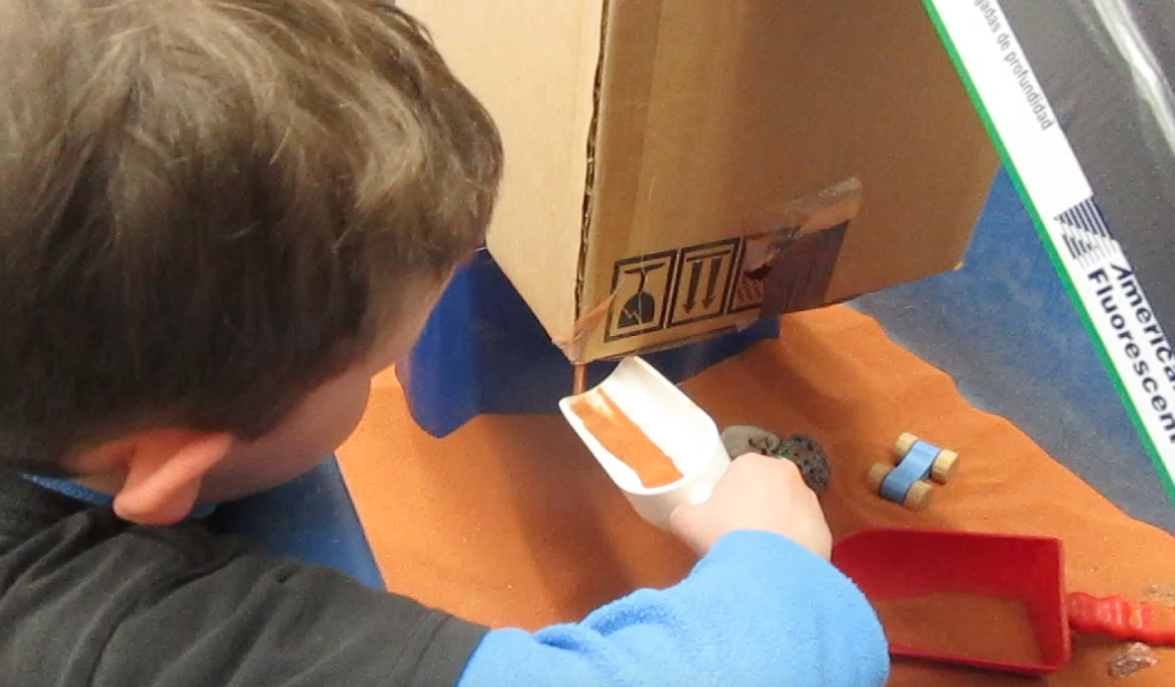
By way of example, I can look at the children's actions around an apparatus I call the sand cascade. The apparatus consists of a large box rising vertically from the table.  Embedded at an angle through the large box is a long narrow box with a hole at the top.  When children pour sand in the hole, it exists at the bottom into the tub at the end of the table.  The children cannot see the sand traveling through this box because it is a closed chute.

A second, narrow box is taped on top of the long embedded box.  Because this chute is open, the children can follow the sand flowing down and out from this box.

In the picture below, two three-year-olds pour sand down the open chute and watch it fall into the bucket in the tub next to the table.

If you click on the following link, you can see the video of these two pouring sand down the chute: https://vimeo.com/485607849

Of course, with my adult/fettered imagination that is exactly what I expect.  I can imagine the children pouring faster or slower; I can imagine them using larger or smaller containers from which to pour; I can even imagine children down at the bottom catching the sand.  

I could also imagine children discovering the top hole of the embedded box for their operations.


In hindsight, I could not have imagined a child noticing the leakage of sand from underneath the top chute.  

Nor could I have imagined a child finding the leakage from the bottom corner of the large box rising vertically from the table.  

In both instances, the noticing leads to the children's actions of catching the sand from the unexpected streams of sand coming from two different features of the apparatus.  In turn, their actions cultivate their ability to focus their observations about some properties of the sand and some fairly inconspicuous features (the leakages) of the apparatus.  Thus, the noticing leads to actions which lead to focused observations.  What is significant in these two cases is that the noticing happens on the unruly edges of the apparatus.  

To better understand children and their worlds, we need to look at their worlds through their eyes.  So often we try to encourage children to focus on what we think is important.  Instead, we might try to open our fettered imagination to see what else is going on.  In the book The Art of Scientific Investigation, W. I. B. Beveridge validates this idea when he asserts the following: "We need to train our powers of observation to cultivate that attitude of mind of being constantly on the look-out for the unexpected and make a habit of examining every clue that chance presents." (p. 32).  In other words, we need to pay attention to the "unruly edges" of children's actions to respect their acute art of noticing.

Tuesday, November 17, 2020

Unsupervised play in the classroom

I have read that children no longer have as much unsupervised play compared to earlier generations.  I have also read that academics now crowd out free play for children in early childhood programs. I am wondering what is the difference between unsupervised play and free play?  Unsupervised play connotes an absence of an adult overseeing children's play. Otherwise, they are quite similar in that the children wholly choose their actions in an ever shifting dance of reciprocity. That makes me wonder: Can there really be anything like unsupervised play in the classroom? 

To give a context to my wondering, I would like to look at an play episode around a very simple apparatus comprised of two sensory tables connected by a wooden tray.

Not only is the apparatus simple, but so are the material provisions. The tables and tray contain only white sand and glass gems for this play episode.
In the photo below, seven children all seem to be engaged in their own operations that span the two sensory tables.

After about ten minutes, the children have all coalesced around the small sensory table. Since I am across the room, I do not know what has happened to bring them all together for a joint endeavor.

Play trajectory from Thomas Bedard on Vimeo.

By the time I am able to get over to the sensory tables, the joint endeavor has already dissolved into play fragments of one or two children doing their own thing.
This is certainly free play. The children choose the trajectory of their play from moment to moment. That includes how to engage with the materials and with whom to engage them with. In other words, the play agenda is theirs. There is no adult directly overseeing their play or directly participating in their play. It's as if there is no adult supervising their play. That does not mean their is no adult supervision. It does mean that the supervision is imperceptible to the children.  That leads to another question: If the children do not register that there is an adult around, is that the same as unsupervised play?

I do not have an answer to that question, but I do think there is value to the idea that a teacher can fade into the background so free play looks a lot like unsupervised play.  The value comes from opening up multiple possibilities for children to create a dynamic flow in their play that an adult often sees as disjointed and illogical.  However, that dynamic flow is one of vitality and joy in which the children create their own worlds of sense and nonsense free of adult scrutiny and judgement.  Those worlds of sense and nonsense offer a priceless window into a realm of childhood that is often lost in the classroom.

Tuesday, November 10, 2020

Fire fighting helicopter

How does a minnow net full of sand and a bowl over a tower apparatus become a fire fighting helicopter in the hands of a child?
It begins with the child lifting the bowl and the minnow net over the top of the apparatus. Once over the top of the apparatus, the child lifts the minnow net full of sand out of the bowl. As he does that, he notices how the minnow net disperses the sand. Not only that, he sets the minnow net in motion as he covers the top of the appartus with the sand.
As the flow of sand dwindles, he scatters that last bit of sand back into the table.
At this point, he switches strategies. Instead of filling the minnow net with sand and placing it in the bowl so the sand stays in the net, he fills his bowl with sand and pours it into the net over the top of the apparatus. That way, he gets a more vigourous flow from the minnow net.
Again, as the flow dwindles from the minnow net, the child moves the final bit of sand over the side of the apparatus that has the cascade incline.
Below is the video of the episode. It clearly shows his focus on how the minnow net disperses the sand. As he scoops sand into his bowl for a second pour, he reveals that helicopters have something that they pour over fire.

Fire fighting from Thomas Bedard on Vimeo.

It is the child's enterprise to make sense of the world. Sometimes that is as simple as pouring and filling a container with sand. (Actually those operations are not as simple as they seem. See The Art of Pouring.) Sometimes the child brings a certain experience or prior knowledge to the operation of filling and pouring that adds a representational element to something observed in the world. I am not sure the child in this episode has seen a real life helicopter fighting a fire, but he could have easily seen one depicted in a book or video. By bringing his prior knowledge to his exploration at the sensory table, he is able to represent how such a helicopter works. There are several features to his actions which may be salient for him as he depicts the fire fighting helicopter, but one that stands out is how the "stuff" to put out the fires is dispersed; the minnow net offers a credible facsimile of the fire-fighting actions of such a helicopter. As of yet, he does not have the word disperse in his verbal repertoire, but he certainly does in his developing repertoire of physical and observational operations. Without a real or play helicopter in sight, I guess that is how a minnow net full of sand and a bowl over a tower apparatus becomes a fire fighting helicopter.