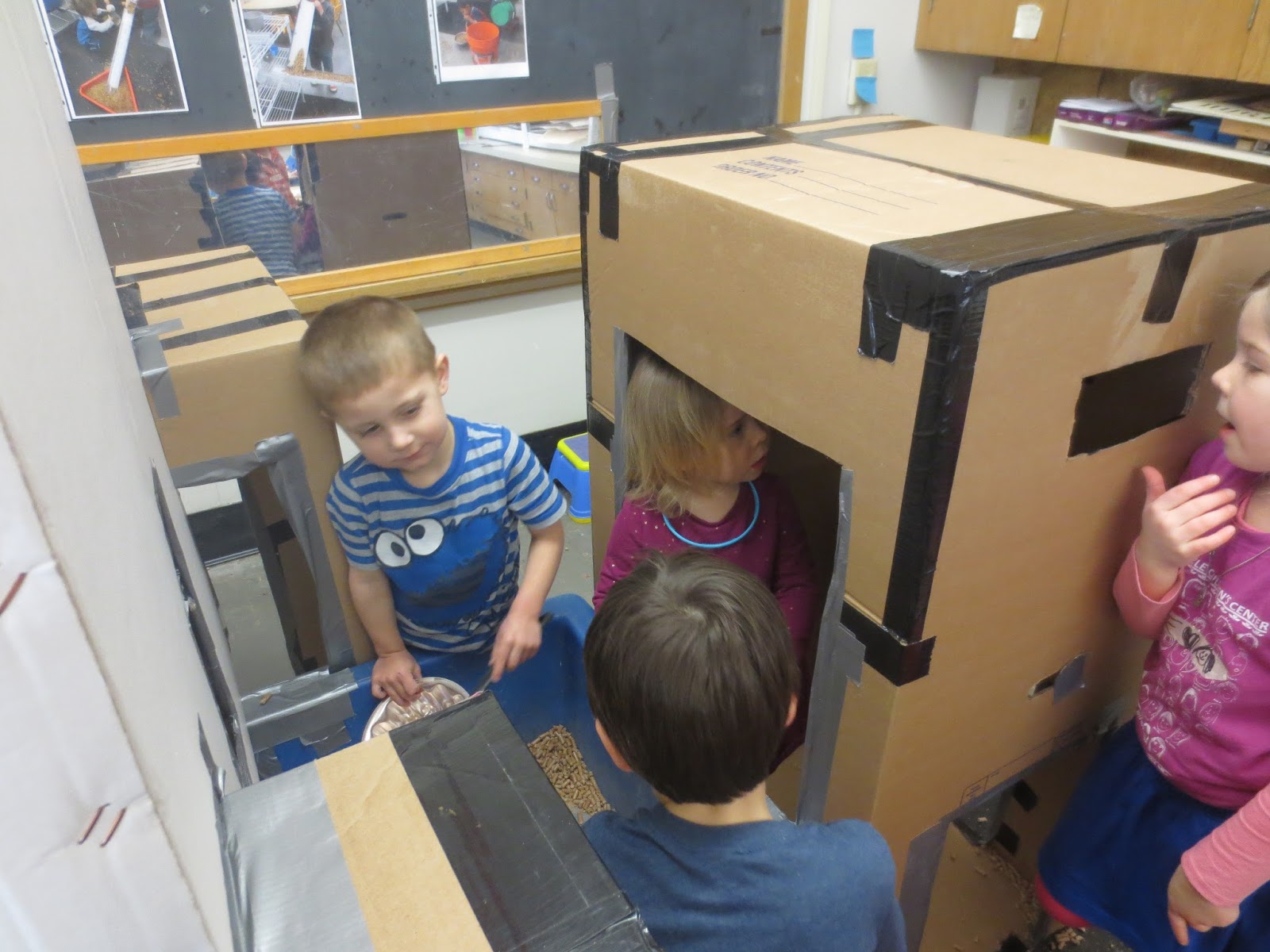
For the past four weeks I have been writing about aspects of play at an installation called "big boxes around the table." Catchy title, no? The aspect of play for this post is the connections between play and the space in which that play is realized.
For this installation, the sensory table was encased in five large boxes. In essence the apparatus created unique spaces that invited children to explore. The title may not be catchy, but the invitations for play were quite fetching.
The children played in those spaces by inhabiting them and giving them life. Some of that play was physical.
The picture above captured a child in two boxes at the same time. He was standing with his feet and legs in one box and his head and torso in another box. If you look closely, you can see the child's head and hand in the window of the one box. The space was so cramped that only one arm and hand could fit around the child's head at a time.
Some of the play was solitary, like the child who found himself alone scooping pellets after everyone else left.
However, the majority of play must be categorized as social. There were so many examples of social interactions, but let me give you just two. The first actually took place next to the setup. We often forget about the spaces created around an apparatus; children do not. In the picture below, the children have settled into the space between the boxes and the cabinets to do their cooking. They have taken the pellets from the table and the containers and utensils from the white shelves. In this case, too, the floor was an important factor in determining the space.
Could this play have happened without the installation? Does the installation have any role in sustaining this all-consuming social enterprise? The children's bodies and their containers contributed to defining the space in which they were working. Maybe the actualization of the children defining that space was more crucial to the social engagement than the original space created by just the apparatus.
Even though the setup from the example above may not have been the critical piece for the social interaction, that same setup did play an important role in the following scenario. In the video, one child was the witch collecting "potions" from the other two children.
Gathering potions from Thomas Bedard on Vimeo.
The setup in this example would seem to be a main character stimulating this scenario. There was place up high to gather the potions. Was it a castle? The witch came down from the perch to collect the potions from her helpers working in spaces that felt like nooks and crannies. After gathering the potions, she returned to her place in the sky.
There was more to this scenario. After she gathered her potions, she came down from her perch to give instructions to her helpers.
Witches instructions from Thomas Bedard on Vimeo.
I do not know what she said to them, but the cackle of the witch was unmistakable. She did, in fact, tell me early on that she was a witch collecting potions.
When I showed her mother this video, she was able to give me more context to this play. She had recently been reading Harry Potter to her daughter and her daughter was smitten. So here she was, making some sense of a story her mother had read to her. She could not do it alone, so she enlisted the help of others. The others probably had no idea about the scenario but were perfectly willing to play along because she carried the plot of the story. Not only that, she did it with such passion.
What makes these social engagements so powerful is that they are authored by the children without adult interference. They are authored by the children using a complex set of factors, some of which are the spaces available to them. Sometimes those spaces play a lesser role; children can play cooking in any number of spaces. It is true, it would take a different form, but it is still cooking. Other times the space is critical. A Harry Potter play needs a castle with perches and nooks and crannies to fabricate a good rendition of the magical tale.
This is a blog for early childhood teachers looking for ways to expand and enrich play and learning in and around their sand and water tables with easy-to-make, low-cost apparatus. It may also be of interest for anyone who appreciates children's messy play.
About Me
- Tom Bedard
- Early childhood education has been my life for over 40 years. I have taught all age groups from infants to 5-year-olds. I was a director for five years in the 1980s, but I returned to the classroom 22 years ago. My passion is watching the ways children explore and discover their world. In the classroom, everything starts with the reciprocal relationships between adults and children and between the children themselves. With that in mind, I plan and set up activities. But that is just the beginning. What actually happens is a flow that includes my efforts to invite, respond and support children's interface with those activities and with others in the room. Oh yeh, and along the way, the children change the activities to suit their own inventiveness and creativity. Now the processes become reciprocal with the children doing the inviting, responding and supporting. Young children are the best learners and teachers. I am truly fortunate to be a part of their journey.
Saturday, May 14, 2016
Saturday, May 7, 2016
Scientific inquiry: measuring space
I have always thought of my sensory table as a science table at which the children conduct their own experiments. I set up an apparatus to be explored. The children are given free range to use the apparatus, the medium and the loose parts to come up with their own theories about how the physical world works. For the latest setup, big boxes around the table, the children used the installation to measure physical space. Measuring, after all, is a form of scientific inquiry. Here is the setup.
There are six large boxes that for all intents and purposes encase the blue sensory table. Boxes 1, 2 and 4 are wardrobe boxes affixed to three sides of the table. Boxes 3 and 5 form a connection between the wardrobe boxes. Box 6 stands alone but is open to the table. The installation creates a myriad of spaces over, under, around and through. The children find and measure all the spaces.
Here is an example of two children measuring the spaces created by three of the boxes (1, 3 and 4).
How exactly are they measuring those spaces? They did it with their bodies. The child in the box had to first figure out how to get in the box. Taking a measure of the opening, she figured out she had to crawl in. Once in, she could have stood up. Instead, she decided to kneel, probably because the parameters of the box she was sensing made it easier to work from that position. The child outside the box is also carrying out multiple measuring operations. She is giving pellets to the child in the box through the window in the connecting box (3). To do that, she measures the space between the two big boxes, the area under the connecting box, the height of hole in the connecting box, and the size of the hole. In doing all that, she has brought over a stool so she can reach as far into the connecting box as possible to give her friend pellets.
Here is another example of children measuring space both inside and outside the boxes from the other side of the apparatus, in this case, the boxes 2, 4 and 6. One child is in the wardrobe box, one child stands next to the wardrobe box and two children are in the between spaces created by the three wardrobe boxes.
How do these children measure the spaces? If you notice, each one is leaning up against a box essentially assaying one of the boundaries of each of their spaces.
Speaking of boundaries, here is a photo a child assessing the upper boundaries of this apparatus.
This is an excellent example of a child finding spaces to explore that are on top of an apparatus. I always tell others to build to their comfort level because the children will go as high as you build. However, as you learn more about your children and what they are capable of, you may want to stretch your comfort zone so the children can more accurately measure their own risk.

There was one space in which a child could actually measure the distance all the way through a box, box 3. One child reaches through the box to see if she can reach her brother on the other side.
Another choice example of a child measuring the space with her body comes from inside box 2. The child is sitting inside the box. To get pellets from the table, she has to reach through a narrow opening created by the connecting box 5 that bisects the original opening in box 2.
She measures both the length of her arm reaching into the table and the width of her face wedged between the spaces created by the two boxes. By the way, she maximizes her reach by wedging her face into that space.
There are many more spaces to measure in the apparatus. However, it is easy to forget some spaces that are not so perceptible---except to the children. Those are the spaces that are next to the setup in which children find clear boundaries in which to operate. Here is one of those spaces.
In this case, the space is created by box 2, the shelves, the wall and the floor. Using her body, she helps create a space that is enclosed on three sides. In essence, she has measured the space so now she is part of the boundary.
Axiom #2 on the right hand column of this blog states that children will explore all spaces in any given apparatus. When they are exploring those spaces, they are also conducting a form of scientific inquiry by measuring those spaces. They measure the spaces with the instrument they know best: their bodies.
There are six large boxes that for all intents and purposes encase the blue sensory table. Boxes 1, 2 and 4 are wardrobe boxes affixed to three sides of the table. Boxes 3 and 5 form a connection between the wardrobe boxes. Box 6 stands alone but is open to the table. The installation creates a myriad of spaces over, under, around and through. The children find and measure all the spaces.
Here is an example of two children measuring the spaces created by three of the boxes (1, 3 and 4).
How exactly are they measuring those spaces? They did it with their bodies. The child in the box had to first figure out how to get in the box. Taking a measure of the opening, she figured out she had to crawl in. Once in, she could have stood up. Instead, she decided to kneel, probably because the parameters of the box she was sensing made it easier to work from that position. The child outside the box is also carrying out multiple measuring operations. She is giving pellets to the child in the box through the window in the connecting box (3). To do that, she measures the space between the two big boxes, the area under the connecting box, the height of hole in the connecting box, and the size of the hole. In doing all that, she has brought over a stool so she can reach as far into the connecting box as possible to give her friend pellets.
Here is another example of children measuring space both inside and outside the boxes from the other side of the apparatus, in this case, the boxes 2, 4 and 6. One child is in the wardrobe box, one child stands next to the wardrobe box and two children are in the between spaces created by the three wardrobe boxes.
How do these children measure the spaces? If you notice, each one is leaning up against a box essentially assaying one of the boundaries of each of their spaces.
Speaking of boundaries, here is a photo a child assessing the upper boundaries of this apparatus.
This is an excellent example of a child finding spaces to explore that are on top of an apparatus. I always tell others to build to their comfort level because the children will go as high as you build. However, as you learn more about your children and what they are capable of, you may want to stretch your comfort zone so the children can more accurately measure their own risk.
There was one space in which a child could actually measure the distance all the way through a box, box 3. One child reaches through the box to see if she can reach her brother on the other side.Another choice example of a child measuring the space with her body comes from inside box 2. The child is sitting inside the box. To get pellets from the table, she has to reach through a narrow opening created by the connecting box 5 that bisects the original opening in box 2.
She measures both the length of her arm reaching into the table and the width of her face wedged between the spaces created by the two boxes. By the way, she maximizes her reach by wedging her face into that space.
There are many more spaces to measure in the apparatus. However, it is easy to forget some spaces that are not so perceptible---except to the children. Those are the spaces that are next to the setup in which children find clear boundaries in which to operate. Here is one of those spaces.
In this case, the space is created by box 2, the shelves, the wall and the floor. Using her body, she helps create a space that is enclosed on three sides. In essence, she has measured the space so now she is part of the boundary.
Axiom #2 on the right hand column of this blog states that children will explore all spaces in any given apparatus. When they are exploring those spaces, they are also conducting a form of scientific inquiry by measuring those spaces. They measure the spaces with the instrument they know best: their bodies.
Saturday, April 30, 2016
Big boxes around the table - additions
For the past month I have been writing about big wardrobe boxes that were first set up as a fort in the large muscle area of the classroom.

Four big wardrobe boxes were taped together with passage ways between the boxes on the inside and openings all around and on top for the children to peek out of and into.
I moved the boxes from the large muscle area to the sensory table. I disconnected all the boxes and set one on each side of the table.

In this configuration, the space over the table is open and can be accessed by the children either through the spaces in-between the boxes or from inside the boxes themselves.
To this setup, I added two new boxes. One of the boxes was an iMac box. This box was embedded on one end into one of the wardrobe boxes and embedded on the other end into the second new box, a large wreath box.
Here is the view of the iMac box from inside the wardrobe box looking toward the wreath box. The iMac box has such an interesting shape being wider at the bottom than at the top. It defines a space not usually experienced by children. The iMac box also changes the shape of the wardrobe box window into the sensory table. Children inside the wardrobe box can gather or transport pellets from the table or the iMac box.
It looks like the iMac box is suspended in midair, but it is embedded in the wreath box and then taped to the wardrobe box in such a way that it is quite stable. Pieces of duct tape run from the bottom of the iMac box to the top of the wardrobe box.
The wreath box spans the width of the table and is embedded into the two wardrobe boxes on either side. The box rests on the lip of the table on either side to add strength to the structure.
With these additions the space changed significantly. Children could no longer just scoop pellets from the space over the table unimpeded. The area above the table was now partially closed creating restrictions to their operations. The video below illustrates two of those restrictions: 1) having to reach around and under the apparatus for pellets and 2) having to reach into the narrower iMac box for pellets.
Under and through from Thomas Bedard on Vimeo.
For the girl to reach under the apparatus to gather the pellets, she has to reach down and around the apparatus. That is a physical and balancing challenge as it is, but to complete the transfer of pellets into her bucket, she has to reverse the whole operation. For the boy to gather his pellets, he has to almost crawl into the iMac box.
In both of these instances, the children can see the pellets they are gathering. One child found a way to scoop pellets even though she could not see them. She is in a wardrobe box and wants to get pellets from the bottom of the sensory table. She figures out she could reach through a small opening created by the wreath box bisecting the original window in the wardrobe box. Only her arm fits through the opening and she has to wedge he head between the wreath box and the wardrobe box to reach the pellets. As a consequence, she cannot see what she is doing. Watch.
Tight spaces from Thomas Bedard on Vimeo.
explore spaces
Four big wardrobe boxes were taped together with passage ways between the boxes on the inside and openings all around and on top for the children to peek out of and into.
I moved the boxes from the large muscle area to the sensory table. I disconnected all the boxes and set one on each side of the table.

In this configuration, the space over the table is open and can be accessed by the children either through the spaces in-between the boxes or from inside the boxes themselves.
To this setup, I added two new boxes. One of the boxes was an iMac box. This box was embedded on one end into one of the wardrobe boxes and embedded on the other end into the second new box, a large wreath box.
Here is the view of the iMac box from inside the wardrobe box looking toward the wreath box. The iMac box has such an interesting shape being wider at the bottom than at the top. It defines a space not usually experienced by children. The iMac box also changes the shape of the wardrobe box window into the sensory table. Children inside the wardrobe box can gather or transport pellets from the table or the iMac box.
It looks like the iMac box is suspended in midair, but it is embedded in the wreath box and then taped to the wardrobe box in such a way that it is quite stable. Pieces of duct tape run from the bottom of the iMac box to the top of the wardrobe box.
The wreath box spans the width of the table and is embedded into the two wardrobe boxes on either side. The box rests on the lip of the table on either side to add strength to the structure.
Children access the wreath box through the hole cut in the side seen in the picture above and through holes cut in the ends of the wreath box where they are embedded in the wardrobe boxes. One of the direct entry points is through the wardrobe box that is not connected to the other boxes and directly faces the wreath box.
With these additions the space changed significantly. Children could no longer just scoop pellets from the space over the table unimpeded. The area above the table was now partially closed creating restrictions to their operations. The video below illustrates two of those restrictions: 1) having to reach around and under the apparatus for pellets and 2) having to reach into the narrower iMac box for pellets.
Under and through from Thomas Bedard on Vimeo.
For the girl to reach under the apparatus to gather the pellets, she has to reach down and around the apparatus. That is a physical and balancing challenge as it is, but to complete the transfer of pellets into her bucket, she has to reverse the whole operation. For the boy to gather his pellets, he has to almost crawl into the iMac box.
In both of these instances, the children can see the pellets they are gathering. One child found a way to scoop pellets even though she could not see them. She is in a wardrobe box and wants to get pellets from the bottom of the sensory table. She figures out she could reach through a small opening created by the wreath box bisecting the original window in the wardrobe box. Only her arm fits through the opening and she has to wedge he head between the wreath box and the wardrobe box to reach the pellets. As a consequence, she cannot see what she is doing. Watch.
If you give a child a long hallway or an open field, the child will run. The spaces tell her to run. In this new configuration of a big box apparatus around the sensory table, there are a lot of tight spaces that restrict and shape how children move and operate in the spaces. Just this morning I was just watching my 10-month-old granddaughter crawl under the table and the rocking chair. What is it about tight spaces that calls the children to action?
explore spaces
Saturday, April 23, 2016
Re-purposing objects
Last week I wrote about the physical challenges children create for themselves. They do it all the time. This particular post was in the context of four large boxes installed on four sides of the sensory table.
Dustpan scoop from Thomas Bedard on Vimeo.
Tube scoop from Thomas Bedard on Vimeo.
Lever and fulcrum from Thomas Bedard on Vimeo.
He could have just lifted the tube to pour the pellets in the bucket, but instead, he uses the lip of the table as a fulcrum to both support the weight of the tube and establish a point on which to rotate the tube to empty it into the bucket. It looks like real-world physics to me.
One child went so far as to bring scissors from the writing area on the other side of the room. I often have children bring things from other areas, but this is the first time someone has brought something from the writing area to use at the sensory table. Watch as she uses the scissors to pick up one pellet at a time from the table and then drop it into a window in the box.
Scissors as pincher from Thomas Bedard on Vimeo.
She is very meticulous about making sure she gets only one pellet at a time. In fact, the second time she goes for a pellet, she gets two and drops one before putting the other one in the window.
I could have done the teacher thing and stopped her by saying the scissors stay at the writing table. Instead, I did a different teacher thing: I observed and recorded what I saw. I could not help but think how ingenious this child was to take a writing table utensil and re-purpose it as pincer in the sensory table.
In fact in every instance I referenced, I could have found a reason to stop the actions of the child. For instance I could have said for the first one: "Dustpans are for sweeping." For the second one: "You will loose the pellets out the other end." For the third one: "You are spilling way too much when you fill your tube." If I had done that, though, I would have missed the resourcefulness and the inventiveness of the children as the re-purpose the materials at hand. That idea is transformative because it applies to all other constructions and all other areas of the room and all the materials in the room.
The question is: Does anything go or are there limits to what is allowed?
Another feat the children undertake all the time is to re-purpose materials to suite their own mission at any given time. The examples again come from the same installation of big boxes around the table.
One example of re-purposing something is the child who decides to use a dustpan as a scoop. The dustpans and brooms are always next to the table for sweeping up messes. This child wants a bigger scoop for his operations, so he appropriates a dustpan.
Another adult around the table actually comments on what a big scoop the child has and compares it to a bulldozer.
Another child takes a short, clear plastic tube to make a scoop. That is a bit tricky because the tube is open on both ends. Watch how carefully he proceeds so he does not loose any pellets out of the other end of the tube.
He is careful, that is, while scooping and lifting the pellets out of the table. However, when he is ready to pour, he quickly launches the pellets into the bucket. Most of the pellets end up in the bucket, but some fly out the other end.
Another child takes a long, clear plastic tube for a lever on a fulcrum to transport the pellets from inside the table into a bucket next to the table. Because the high end of the tube reaches beyond the table, he spills a fair amount of pellets on the floor.
He could have just lifted the tube to pour the pellets in the bucket, but instead, he uses the lip of the table as a fulcrum to both support the weight of the tube and establish a point on which to rotate the tube to empty it into the bucket. It looks like real-world physics to me.
One child went so far as to bring scissors from the writing area on the other side of the room. I often have children bring things from other areas, but this is the first time someone has brought something from the writing area to use at the sensory table. Watch as she uses the scissors to pick up one pellet at a time from the table and then drop it into a window in the box.
Scissors as pincher from Thomas Bedard on Vimeo.
She is very meticulous about making sure she gets only one pellet at a time. In fact, the second time she goes for a pellet, she gets two and drops one before putting the other one in the window.
I could have done the teacher thing and stopped her by saying the scissors stay at the writing table. Instead, I did a different teacher thing: I observed and recorded what I saw. I could not help but think how ingenious this child was to take a writing table utensil and re-purpose it as pincer in the sensory table.
In fact in every instance I referenced, I could have found a reason to stop the actions of the child. For instance I could have said for the first one: "Dustpans are for sweeping." For the second one: "You will loose the pellets out the other end." For the third one: "You are spilling way too much when you fill your tube." If I had done that, though, I would have missed the resourcefulness and the inventiveness of the children as the re-purpose the materials at hand. That idea is transformative because it applies to all other constructions and all other areas of the room and all the materials in the room.
The question is: Does anything go or are there limits to what is allowed?
Saturday, April 16, 2016
Children and physical challenges
The big box fort that was set up in the large muscle area of my room is now history.
The fort is gone, but the boxes have been re-purposed to create an new apparatus at the sensory table. I separated the four boxes and positioned them around the four sides of the sensory table.
Unlike the fort, the boxes are now their own separate cubbies. For the most part, the openings remained the same except for the ones facing the table. I had to expand those holes otherwise the children would not be able to reach into the table from the boxes. Even though I made those holes bigger, there was an inherent physical challenge for the children to work from inside the box.
Contortionist from Thomas Bedard on Vimeo.
Why would a child do this? Maybe he invented a moment in time in which he was both creator and agent of his own actions. How compelling would that be for a child?
A drop in the bucket from Thomas Bedard on Vimeo.
The fort is gone, but the boxes have been re-purposed to create an new apparatus at the sensory table. I separated the four boxes and positioned them around the four sides of the sensory table.
Unlike the fort, the boxes are now their own separate cubbies. For the most part, the openings remained the same except for the ones facing the table. I had to expand those holes otherwise the children would not be able to reach into the table from the boxes. Even though I made those holes bigger, there was an inherent physical challenge for the children to work from inside the box.
You can see in the picture above that a child inside the box had to bend his back to stand up to work in the table. Of course, an easy solution to the problem was to work from your knees like the two girls below kneeling in the boxes while scooping pellets. Was that comfortable? Imagine the new perspective the children experienced with their chin on the lip of the table while scooping pellets.
One of the features of this setup is that it created spaces in-between the boxes for the children to work in. In the picture above, the boy in the red was working in such a space. The boxes constituted physical barriers to his operations. Since he could not go side-to-side, perhaps he had to lean in further for his enterprise. In the picture below, you can see four children working from inside each of the four boxes, but two children are working in those in-between spaces.
Here it is easier to see that the boxes made it imperative to lean into the space over the table to coordinate their scooping and pouring.
Only two of the boxes had holes in the top. And the children found both of them and used them for their operations. The endeavor through one of the holes would have made a contortionist envious. Watch how the child in the video below retrieved a pan from the top of the box through a hole that accommodated just his head and his hands.
Why would a child do this? Maybe he invented a moment in time in which he was both creator and agent of his own actions. How compelling would that be for a child?
Speaking of physical challenges, watch these two children drop pellets through the hole in the top of the box into the orange bucket they had set up inside the box.
Just by itself, it was a physical challenge to drop the pellets from a height into the bucket, but these two did it while climbing up and balancing on the lip of the table.
These are
good examples of a physical challenges the children create for themselves.
Over the past couple of years, I have come to appreciate those
physical challenges and how the children actualize them. In fact, it is the 9th axiom in the right hand column of this blog. Given the time, the space, the resources and the freedom to explore, the children invariably search out their own unique physical challenges to create moments of agency and mastery in their world/s.
Saturday, April 9, 2016
How do children explore spaces?
Before I return to the sensory table, I would like to take a second look at this year's big box fort with a little different lens. Last week I wrote about literacy in connection with the fort. This week, I would like to examine how the children explore spaces in and around the big box fort. I connected four big wardrobe boxes so children could crawl in, out, and through boxes.
There are no doors on the side facing the room. In fact, there is only one window in box #3 that faces the rest of the room. Box #2 has no doors, only windows. Box #2 is connected with the other three boxes with inside portals.
Box #1, #3 and #4 each has an outside doors. The doors on boxes # 3 and #4 open on one end of the fort.

The question is not only how do we empty the box, but what space do we use for the stuff as an interim to putting it all away?
There are no doors on the side facing the room. In fact, there is only one window in box #3 that faces the rest of the room. Box #2 has no doors, only windows. Box #2 is connected with the other three boxes with inside portals.
Box #1, #3 and #4 each has an outside doors. The doors on boxes # 3 and #4 open on one end of the fort.
The door for box #1 opens out the back of the fort.
The highlighted square shows one corner of an inside passage with the dotted line representing the part of the inside door that is not visible. Children crawl through that passage to move through the fort.
When children explore these spaces, they do more than just crawl from one box to the other. They do that, but they also inhabit those spaces in different ways. One way is to do it with others.
That gets provocative when a couple of children settle into a space and a third child either wants to join them or pass through. How do we fit in this space and how can we accommodate more?
Another way to explore the spaces is to see what happens when we stand up. In the taller box, we have a small window to the world. Our bodies our inside,but our mind is looking out.
The shorter boxes offer the children the chance to be both in and out of box. How much of me can be out and how much of me can be out?
Can two of us be both out and in?
Another way to explore the spaces is by filling them with something. One group this year filled one of the end boxes with blocks and anything else they could find to put down the hole in the top of the box.
Of course, not everything they found fit in the top.
Filling up the box gave the children another way to explore spaces. How do we empty the spaces we filled?

The question is not only how do we empty the box, but what space do we use for the stuff as an interim to putting it all away?
Children like to explore the in-between spaces, too. One of those in-between spaces is wall with the cardboard window. You can see from the video below that it fosters a gleeful game of peek-a-boo.
Here is a more active game of peek-a-boo in which the children use all the spaces inside the fort and outside the fort.
The boy on the outside runs around the whole fort looking in windows and doors to see the child inside the structure. The boy inside the structure crawls from one end of the fort to the other. In the end, the boy on the outside peers in the window and can see the other child exiting the fort on the other side. The boy on the inside was inhabiting the inside spaces while the boy on the outside was inhabiting the spaces created by the structure on the outside. They were doing it together each in their own spaces.
How do children explore spaces? First, they find all the spaces. That includes all the spaces in, around and in-between Then the children act upon those spaces; they breathe life into those spaces. Children give those spaces meaning literally and figuratively by filling them with their play.
Saturday, April 2, 2016
Big box fort and literacy
This week I am not writing about an apparatus at the sensory table. Rather, I write about a structure I built in the large muscle area of my classroom. ( I always have large muscle play in my classroom as an option for the children who need to move when they need to move. That is pretty much all children.) Rest assured that it portends things to come in the sensory table.
Let's face it, I like cardboard boxes. I especially like big boxes because big boxes allow for the creation of appealing spaces that the children can explore inside and out with their whole bodies. One of the things I like to do with big boxes is to connect them to form a fort with interconnecting rooms with multiple ways in and out and multiple windows to peek in and out of. Two years ago, I wrote about a box fort I set up the large muscle area of my classroom.
The fort consisted of five boxes of different sizes interconnect with passage ways on the inside and windows and doors all around.
The play was so good and so rich, that I wanted to do it again when the opportunity presented itself in the form of multiple big boxes. It just so happened that last November my daughter and son-in-law moved back to town with a moving company. Moving companies use wardrobe boxes for packing up clothes. I asked for the boxes and saved four for a new box fort for the large muscle area. Large boxes are easily transported if they are broken down so they are flat. They can easily be taped back together to make the big box again.
I have a small SUV so I was able to transport them to school and reconstruct them with duct tape. Below you can see this year's box fort. All four boxes are taped together on the outside and on the inside for greater stability. Boxes 1, 3 and 4 have doors into the fort.
Box 2 is the connecting box that the children pass through as they navigate the inside of the structure. Below is look inside box 2. The doorways to each of the other boxes are denoted (1, 3, and 4).
It looks like there is a traffic jam in the connecting box. No problem, though, because children's sense of space is so much different than that of adults.
Besides the doors, there are six windows. Windows 1, 2, 3, and 4 are on the sides of boxes. Windows 3 and 4 are small narrow windows on two sides of the middle box Windows 5 and 6 are cut in the top of two of the boxes.
Windows 1, 2 and 5 have flaps to open and close. Windows 3, 4, and 6 are open cuts.

The windows offer unique frames through which the children can view each other---both from the inside and from the outside.
There is one particular type of play in and around the fort that caught my eye this year. That particular type of play can be considered literacy play. Let's start on the inside. The fort became a perfect spot for a child to retreat to do her writing.
P.S. On my Facebook page at the end of February, I shared a post (https://blog.kinstantly.com/kids-forts/ ) about the need for children to build forts. The post mostly talks about older children building forts outside, but I think there is a place for forts inside a preschool room, too.
Let's face it, I like cardboard boxes. I especially like big boxes because big boxes allow for the creation of appealing spaces that the children can explore inside and out with their whole bodies. One of the things I like to do with big boxes is to connect them to form a fort with interconnecting rooms with multiple ways in and out and multiple windows to peek in and out of. Two years ago, I wrote about a box fort I set up the large muscle area of my classroom.
The play was so good and so rich, that I wanted to do it again when the opportunity presented itself in the form of multiple big boxes. It just so happened that last November my daughter and son-in-law moved back to town with a moving company. Moving companies use wardrobe boxes for packing up clothes. I asked for the boxes and saved four for a new box fort for the large muscle area. Large boxes are easily transported if they are broken down so they are flat. They can easily be taped back together to make the big box again.
I have a small SUV so I was able to transport them to school and reconstruct them with duct tape. Below you can see this year's box fort. All four boxes are taped together on the outside and on the inside for greater stability. Boxes 1, 3 and 4 have doors into the fort.
Box 2 is the connecting box that the children pass through as they navigate the inside of the structure. Below is look inside box 2. The doorways to each of the other boxes are denoted (1, 3, and 4).
Besides the doors, there are six windows. Windows 1, 2, 3, and 4 are on the sides of boxes. Windows 3 and 4 are small narrow windows on two sides of the middle box Windows 5 and 6 are cut in the top of two of the boxes.
Windows 1, 2 and 5 have flaps to open and close. Windows 3, 4, and 6 are open cuts.
There is one particular type of play in and around the fort that caught my eye this year. That particular type of play can be considered literacy play. Let's start on the inside. The fort became a perfect spot for a child to retreat to do her writing.
On the outside, one child decided to tag one of the boxes with her name. Can you say graffiti?
I pride myself in knowing everything that goes on in my classroom, but I did not see the child do this. The writing table is right next to the large muscle area so I am surprised more children did not get the idea.
The last bit of play around literacy is based on a short video I took of three children playing a made-up game of rollicking balls. One child is outside the structure trying to throw or stuff balls into one of the boxes. Another child is in the box deflecting or throwing out those same balls. The third child in the taller adjacent box keeps reaching through the hole to throw or deflect the balls, also.
The following week, I showed the video to the child in the taller box. After showing him the video, I asked him if he could draw himself throwing the ball. Since this child had not draw much at the writing table, I was surprised that he accepted the challenge. I set up the IPad with the picture of him reaching through the hole throwing the ball and he started to draw.
Did I plan this literacy play? No I did not. I thought I had built a large muscle apparatus that the children could use to explore spaces with their whole body. They did that for sure, but the children created so much more through their play by combining their ideas with the resources, materials and open-ended invitations.
Subscribe to:
Posts (Atom)