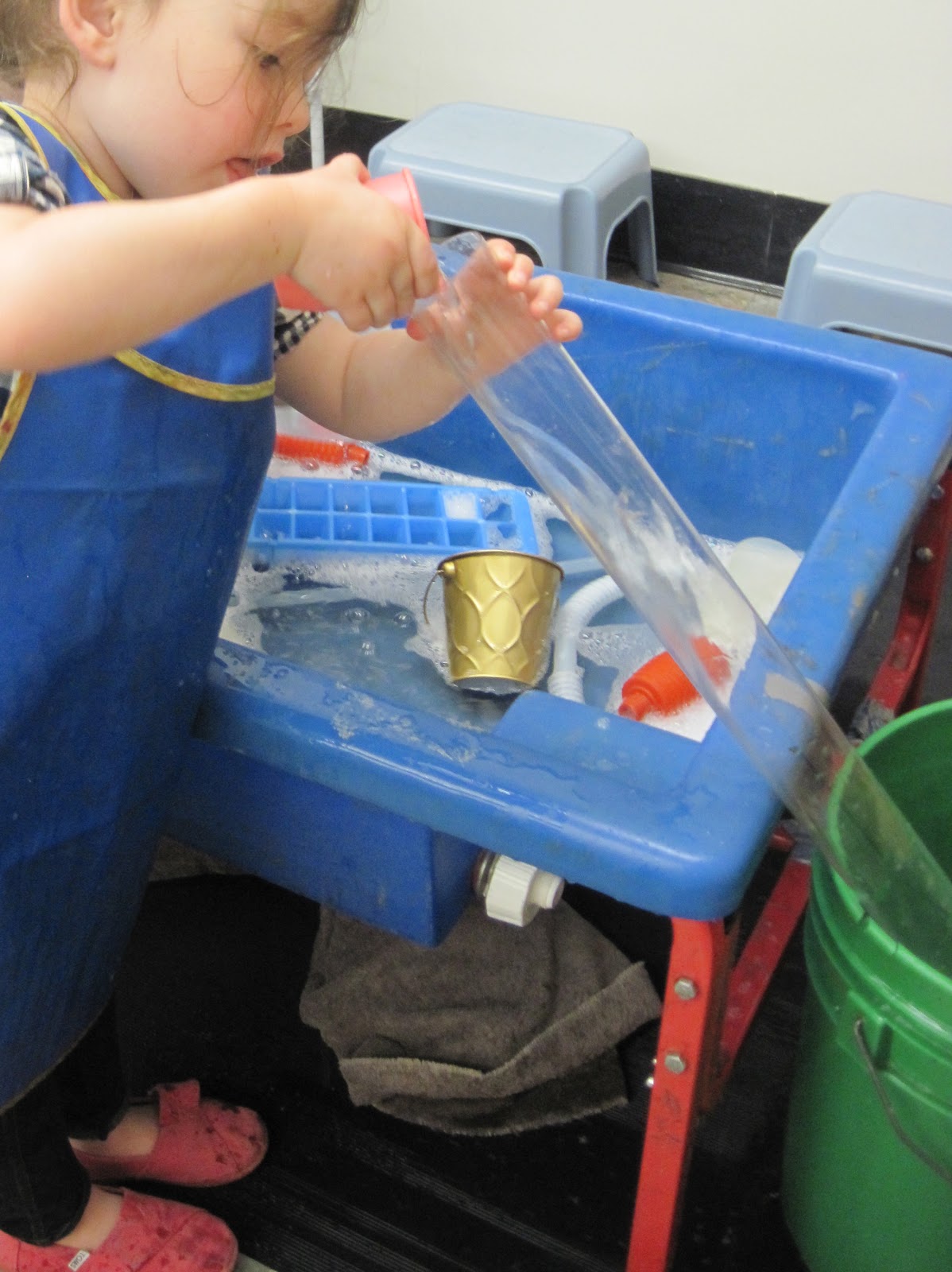
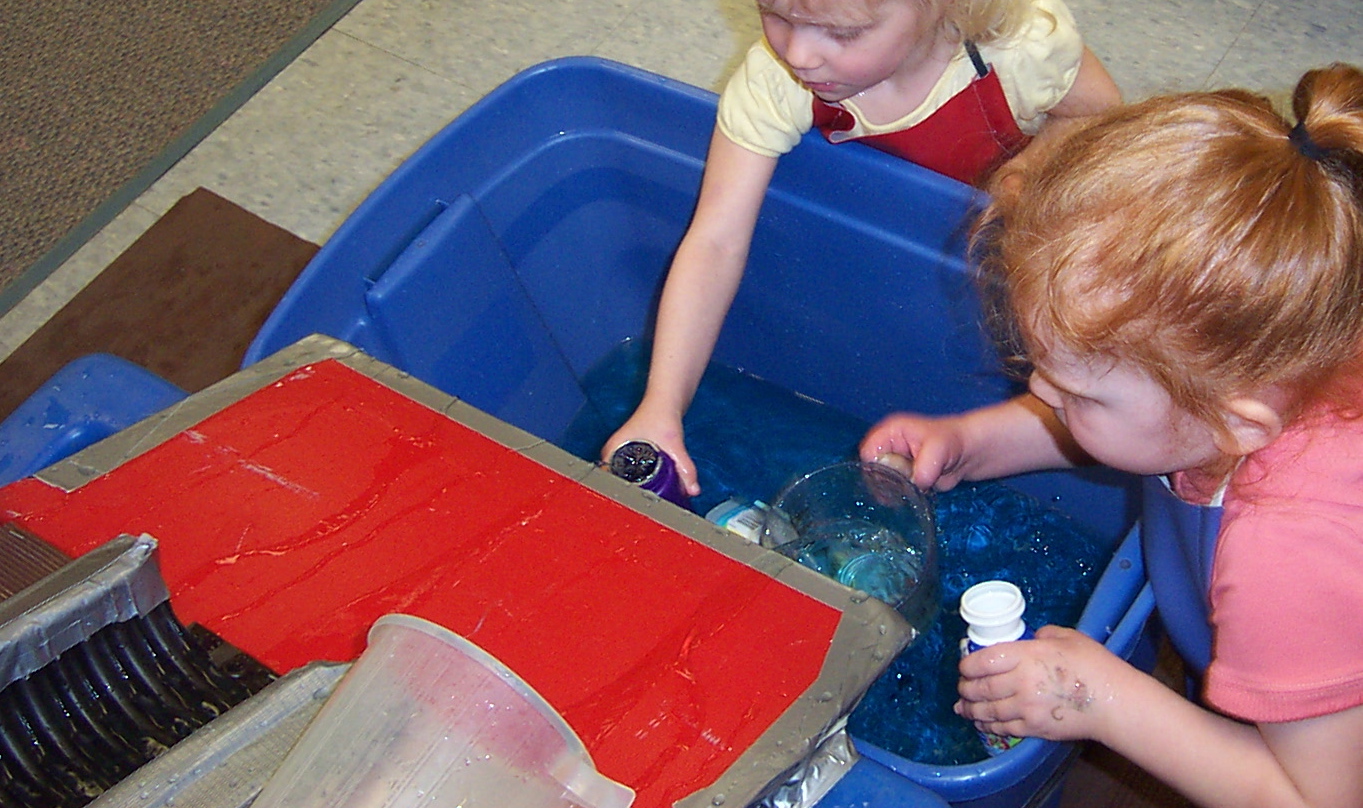
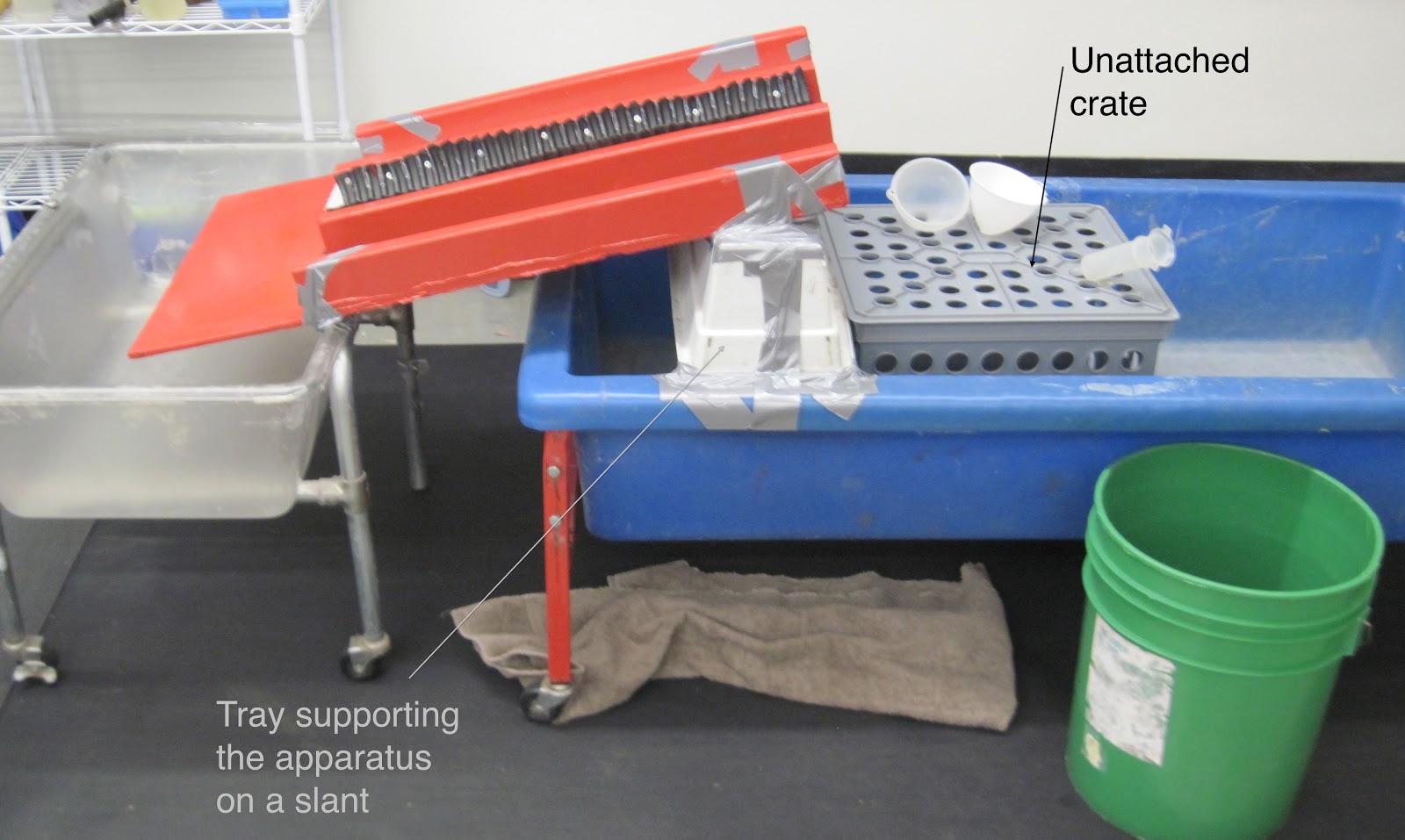
Here is a picture of the wire shelves next to the sensory table in my classroom. What do you see? There is a hodgepodge of pots, pans, and bowls, and a large assortment of doohickies.

It is impossible to show all the exploration, but here is a taste of just some of what happens with hodgepodge and doohickies.
Filling a syringe just to watch the level continually go down because there is a hole in the bottom. This is an operation that gets repeated over and over again.

Using a baster to fill the ice cube tray

Filling a bowl with a scoop with a hole in the bottom. (This is a scoop from a baby formula can.) There are a couple of things to notice about this video. First, the girl has a little trouble taking a measure of how much water to pour from the bottle so the scoop does not overflow. Second, when she figures that out, she is focused on keeping the scoop full without making it overflow. (I see a future scientist taking careful measure with a finely calibrated instrument.)
Filling the jello mold with a funnel and a small measuring cup.

Filling a red bulb with a funnel. The child has to keep her hand on the bottom so the water does not flow out.

Of course after you fill it, you can use it to fill another cup.

Or see what it feels like when you dribble the water down your arm.

The next little video shows this child experimenting with an upside-down funnel in a container. I looked at this video several times before I understood what was going on. The child begins by plunging the upside-down funnel in the bowl. There is some resistance as the funnel pops out of the water. About halfway through the video, she sticks her index finger over the hole of the funnel. That traps the air in so as she pulls up the funnel, she also pulls up water making that operation harder. When she goes to put the funnel back in the water, her finger is still over the hole. That causes the air to displace the water so she has to press down harder on the funnel to put it under the water. At the same time, the funnel wants to slide sideways to let air out and water in. That's a nice little bit of experimenting for a two-year-old. Watch.
Upside-down Funnel from Thomas Bedard on Vimeo.
Remember the syringe in the first picture? In the last video, the child has figured out how to use it to fill the ice cube tray from the butterfly bowl. It is unique but methodical. Watch.
Filling the Ice Cube Tray with a Syringe from Thomas Bedard on Vimeo.
I acknowledge that the pots and pans and bowls and implements available for the children at my sensory table will win no awards for beauty. If awards were given out for fostering creativity, though, hodgepodge and doohickies take the prize.