About Me

My photo
Early childhood education has been my life for over 40 years. I have taught all age groups from infants to 5-year-olds. I was a director for five years in the 1980s, but I returned to the classroom 22 years ago. My passion is watching the ways children explore and discover their world. In the classroom, everything starts with the reciprocal relationships between adults and children and between the children themselves. With that in mind, I plan and set up activities. But that is just the beginning. What actually happens is a flow that includes my efforts to invite, respond and support children's interface with those activities and with others in the room. Oh yeh, and along the way, the children change the activities to suit their own inventiveness and creativity. Now the processes become reciprocal with the children doing the inviting, responding and supporting. Young children are the best learners and teachers. I am truly fortunate to be a part of their journey.

Saturday, March 26, 2016

Don't do this

I have been thinking a lot about the children's need to transport (see Axiom #1 on the right hand column of this blog). 

It began in January with a relatively simple setup that included several pails and tubs around the table so children could transport the sand out of the table.

In the process of writing about how the children explored the setup in a post called transporting,  I began to wonder what would happen if I removed the table completely, leaving only the buckets and tubs to create a transporting paradise.

Without the sensory table, the sole purpose was to move the pellets from container to container.


I decided to have the children work without the table a second week but to add some loose tubes, pipes and channels to see if and how the children changed the process of transporting.

While adding some loose parts, I took away some of the big containers to reduce the clutter.
Along with Axiom #1 on the right, there is its corollary: During transporting, the children will spill.  What that means in practical terms is, if you are ill-disposed to messes, don't do this!  

Let me give you a couple of fine examples of children spilling in the act of transporting with this setup.  The first one is a child attempting to pour pellets into a bottle.  He has a full scoop and the lip of the bottle is small.


Pouring pellets 1 from Thomas Bedard on Vimeo.

Most of the pellets ended up on the floor and not in the bottle.  On closer examination, you can see that there are plenty of pellets on the floor already.

Here is another example of spilling, this time with a child trying to transfer pellets with a spoon into a small pipe.


Pouring pellets 2 from Thomas Bedard on Vimeo.

The child is undeterred even though most of the pellets miss the pipe and end up on the floor.  Only through experimenting does one learn to estimate size of openings and overflow capacity.

If you think spilling is a natural phenomenon and you can tolerate the mess, then there are plenty of examples of children taking advantage of the opportunity to transport.  Here is an example of two children using a tube placed in a channel to transport pellets from one container to another.


Taking turns from Thomas Bedard on Vimeo.

Not only are the children in the video learning to pour carefully into a relatively small opening, but these three-year-olds are taking turns in a joint transporting endeavor.

Remember that small pipe into which the one child tried to dump pellets?  Watch how a little older child figures out how to deposit pellets into that very same pipe.


Fine motor work from Thomas Bedard on Vimeo.


Besides the superb fine motor work, the child continually speculates how many more pellets he thinks he needs to complete his self-appointed task.  And think about the persistence this child exhibits to fill that long, narrow tube!

Here is one more example of the wonder of transporting.  One child has decided to fill a cardboard tube with pellets.  The child pours pellets into the tube and checks the level of the pellets in the tube.  He takes a second scoop and repeats.  This time, though, he sees how close he is to filling the tube and he lets out an understated "ho-ho-ho" of excitement at how close he is to finishing his undertaking.


Filling the cardboard tube with pellets from Thomas Bedard on Vimeo.

Not so long ago, I tried to pour a can of partially frozen juice into a juice container with a small lip.  The result was a huge mess.  What happens when we create messes?  We clean them up.  The same is true for children.  In fact, what a great learning experience to have the opportunity to clean up your own messes.

That said, if it causes you physical pain to see the amount children can spill and the unmitigated mess the children can generate, Don't do this!


Saturday, March 19, 2016

Transporting paradise

Back in January of this year, I wrote a post called transporting.  I ended the post this way: I am now wondering what would happen if I eliminate the table completely.  The shelves would stay, but what if I just put a plethora of buckets and tubs directly on the mats?  Stay tuned.

Well, I did it.  I took my sensory table completely out of the room.  I moved the shelves into the middle of the mat and filled them with scoops, long-handle spoons, and big and small containers.
I set out four, five-gallon buckets and three large tubs.  I turned over one tub for a small table.  I also covered my clear toddler table to create another small table as an elevated work surface.  Here is the setup from two other perspectives. 
The medium I used for this "no sensory table" setup was fuel pellets.  They are compressed sawdust that are manufactured to be burned for heat in pellet stoves.  

More than any other setup, this array of tubs and containers offered children the ways and means for transporting with small, medium, and large containers.

Watch as this 18-month-old transfers pellets from one small container to another.


As you might have noticed, he was not too successful.  That matters little because he is quite content with the trying while sitting on the floor with his legs wrapped around one of the containers.

These three-year-old children were using scoops to transport the pellets from a large container to a plastic garbage pail.
They knew it was a garbage can and as they poured the pellets, they stated: "We're putting garbage in there."  

This four-year-old child takes pellets from a large container and puts them in a triangular-shaped container.  He then pours the pellets into a second large container.  This undertaking is challenging because of the atypical shape of the container he chooses to use to make the transfer.
Here is an example of yet another combination of containers used in transporting.  This time a child pours a five gallon bucket of pellets into a washtub.  He adeptly lifts and tips the green bucket so all the pellets end up in the white washtub.


This is even a greater challenge, not only because the he is wielding a larger container, but also because the washtub in not secure so it moves as he pours the pellets.

Here is an example of transporting from the small table that is part of the setup.  The child is scooping pellets from the washtub to deposit them in the green bucket.


One of the more interesting aspects of this clip is that the child is using a homemade scoop he fashioned by inserting a clear plastic tube into a plastic measuring cup.  The new tool makes it harder to scoop but easier to dispatch the pellets accurately in the green bucket.

Here is one final combination of containers and transporting: containers inside of containers.  The beauty of this operation is the practice the children get with comparing volumes of the different containers.
This setup fostered many more examples of transporting.  The children seized the opportunity to transport to their hearts' content.  You might even conclude that it was a transporting paradise.

I have often been asked for ideas to set up sensory play in a shared space where the sensory table cannot be left out because another group uses the space.  Part of the answer may be to forget about the table and just have a variety of containers that can fit inside each other and then placed on the floor.  Commandeering a small table from the room for an additional work space would add an additional level of play making it more inviting.  

If you can't use a sensory table, never fear, even you can create your own little transporting paradise.


Saturday, March 12, 2016

Baby washing 2016

One of the posts that has gotten the most hits in the five plus years of blogging is the baby washing post.  There is really nothing particularly unusual in an early childhood classroom about washing babies.   Adding a clothesline so children could wash and hang clothes at the same time, though, was out of the ordinary and seemed to spark the interest of other early childhood teachers.
In that first version, I took wood scraps and drilled holes an inch or so from one end which would be the top.  I then taped the wooden rods to the end of the table and then threaded the clothesline through the poles.

This year,  I decided not to use the wooden poles.  Instead I cut PVC pipes for poles.  These poles were sturdier, but just as easy to make.
I decided to make one small change in the configuration of this apparatus.  I strung the two clotheslines at two different levels.  I was thinking of Axiom #3 on the right hand column of this blog: children welcome more levels of play and exploration in an apparatus.  In addition, I added a table (my toddler sensory table with a cover) with towels so the children could bring the babies out of the water to dry them off and dress them as if on a changing table.

It is usually at this point in the blog I write about what kinds of play the apparatus fosters.  This week I will digress.

I work in a family education program called Early Childhood Family Education(ECFE).  The program is part of Community Education in almost every school district in the State of Minnesota.   In my district, the parents and children come once a week for a two hour class.  The class includes a parent and child time together in the early childhood classroom for half hour and a parent education component and early childhood component that run concurrently in separate rooms for the remaining one and a half hours.  Families sign up each semester, but most attend the full school year for a total of 34 to 36 sessions.  My site is one of 11 sites throughout the city.  We have nine separate classes so we serve about 125 families a week.  One of the strengths of this program is that it is an universal access program with tuition based on a sliding fee scale.

Once a semester, the early childhood teacher is asked to go into the parent room to explain what goes on in the early childhood classroom while the parents are in their parent education session.  This past week was the week for me to talk to the parents about what the children are learning in my classroom.

I told the parents that when I come to school each morning I do not know what the children will learn.  That surprised some because they thought I would have concrete learning objectives for all the activities in the room.   That is not to say they will not learn; they are learning machines. Rather, when they come into my room they are able to choose their own activities and direct their own learning.

I like to use concrete examples when I talk to the parents about what the children are learning.  Let me take one from the baby washing setup.  The example really has very little to do with baby washing.  Rather, it is one of those tangential activities in Axiom #7 on the right hand side of this blog.

I approached the clothesline and baby washing table from another area in my room and noticed something unusual.  Why were the pans full of water underneath the changing table?

I stayed around a few minutes and I was able to capture how the pans got there. 


Makeshift oven from Thomas Bedard on Vimeo.

When I asked the child why was he putting the pans under the table, he told me he was cooking and that was his oven. 

So what is the child learning?  Physically, he is learning to control his large and small muscles so he spills as little as possible while he walks and squats down to place the container on the floor.  Social/emotionally, he is learning to negotiate a joint activity with a friend.  Cognitively, he is learning to create a play scenario and solve all the problems that come with sustaining that play scenario.  The beauty of this scenario is that it was authentic, meaning it was coming from the children in an attempt to make sense of their world. 

When I came in that morning, I had absolutely no inkling that baby washing would turn into a cooking experience with the space underneath the changing table turning into makeshift oven.  Actually, it is not unusual for me to not know what will happen on any given day in any given area of my room.  I am comfortable---and energized---in the ambiguity of not knowing.


Saturday, March 5, 2016

Born scientists

I have been reading the book by Alison Gopnik called The Philosophical Baby.  On page 91, she states that children have an innate drive to experiment.  That innate drive, in turn, allows them to learn things that are not innate.  According to her,  they have built-in techniques that help them discover what is not built in.

Her theory appeals to me, especially since I have always considered the sensory table a de facto science zone.  Can I find tangible examples at the table of her theory?

The past two weeks I have written about this year's version of the cardboard divider apparatus. Besides adding a horizontal cardboard tube, I also added two inclined tubes.
With this apparatus, what kinds of experiments do the children undertake using their built-in techniques for discovering their world?

Pouring has got to be one of those built-in techniques.  What happens when a child pours the corn down the tube?  Of course, it depends on how he pours.  If he pours too fast, a lot of the corn misses the tube.  If he pours carefully, he can get most if not all of the corn down the tube.  Watch the concentration on this child's face as he carefully pours the corn.


Pouring down the tube from Thomas Bedard on Vimeo.

What does he discover with his actions that he did not know before?  One thing for sure is how corn slides down the tube.  Such an observant child will file this information away so when the medium changes or the incline changes, he will have prior knowledge with which to to compare his new experiences.

Catching also has to be one of those built-in techniques.  How many ways are there to catch the corn coming out of the tube? The simplest way is to hold your container under the tube to watch it fill.  Or is it?  Watch as the child in the video below figures out how to catch the corn hands-free.  


No-hands catching from Thomas Bedard on Vimeo.

What prompts her to wedge the cup between the tube and the cardboard divider?  It certainly changes the catching experience.  As a consequence, she can carry this experience over to be used when she wants to catch hands-free again in a different context. 

What happens to the catching experience when a child plugs and then unplugs the flow of corn coming out of the tube?  Watch as this child removes the plug he has inserted into the tube.


Blocking the tube from Thomas Bedard on Vimeo.

What goes through his mind as he realizes his container is full and the flood of corn does not abate?  His hands are full so he cannot re-plug the hole.  His understated "whoa" says it all.  Does one learn to control flow by loosing control over the flow?

Is blocking the flow one of those built-in techniques?  The previous video certainly supports that notion.  Watch another example of blocking.  One child pours corn down the tube while the other child blocks the flow of corn---with her eye.


Blocking the corn with an eye part 1 from Thomas Bedard on Vimeo.

Did the child simply want to see the corn sliding down?  What is amazing is that her eye is open until just before the corn hits her eye.  She closes her eye at the last second; flinches as the corn hits her eyelid; and squeals with delight.  I cannot begin to guess what she has learned from this experience.

She must have learned something interesting because her actions are contagious.  The boy who was pouring asks to switch places.  Watch. 


Blocking the corn with an eye part 2 from Thomas Bedard on Vimeo.

These two eye-blocking exploitations may look the same, but they are different.  Whereas the girl wants to see the corn coming down and is happy to let it out, the boy really wants to block the corn for as long as he can.  He presses his eye up against the tube with more force and he uses he right hand for leverage to keep the corn at bay.  He ends up plugging the tube until the corn fills the tube.

I cannot begin to guess what he has learned from this experience.  He has learned something and what he has learned is different from what his friend has learned.  That tells me that the same built-in techniques lead to different outcomes for different people.  What does that mean for standardization of learning for children?

Gopnik also has something to say about this on p. 92:  "When we actively experiment on the world, we are really and truly interacting with a real world outside ourselves, and we can't tell beforehand what lessons the real world will teach."  

I might add that we don't even know what function or purpose those lessons serve down the road of life.   I would like to think that this kind of experimentation leads to the type of exquisite tinkering explicit in this final video.  It is not my video, but it has everything I love: marbles, tubes, funnels, etc.


Saturday, February 27, 2016

Tubes and cardboard dividers

 Last week I wrote about cardboard dividers and a new type of play that emerged from the setup.

I left the cardboard divider up a second week, but I added three different tubes to the construction. First, I embedded a cardboard tube horizontally through the two walls on one side of the divider.  The cardboard tube reached over into the second table.  Second, I attached a clear plastic tube through the two walls on the same side of the divider as the cardboard tube.  The clear plastic tube was set on an incline so it would empty into one of the slots cut in the cardboard tube.
Third, I secured a white PVC tube through the divider on the other side of the installation.  That tube was also set on an incline and emptied back into the table into a corner cubicle on that same side.

Last week, there was a lot of play through the windows.  There was still some of that play, but children definitely changed the focus of their explorations to the tubes. 

The tubes, much like the windows, connected children in play across the cardboard walls.  Some of the play was as simple as filling your friend's container. 
Or was it so simple?  For this to work, there had to be ongoing coordination and communication. 

One of the big surprises for me was how children combined the tubes and windows in their operations.  A child in the video below figured out that he could insert a jello mold into the window so when his friend poured corn down the white tube, it helped fill the container.  In the video, watch their joint endeavor.


Filling the jello mold from Thomas Bedard on Vimeo.

The child pouring corn into the tube seemed to keep checking every time he would send some corn down.  These three-year-old children definitely worked together, but in a very complicated dance.

Here is another example of how the children modifyied the apparatus by using both a tube and a window. The children in the video figured out how to wedge a dust pan at the end of the clear plastic tube by using the window.  


Dust pan modification from Thomas Bedard on Vimeo.

As you can tell, they were very pleased with themselves because they figured out how to divert the corn coming out of the clear plastic tube.  The thrill may have been magnified by the fact that the corn was bouncing wildly on the floor.

I have always thought of the sensory table as a blank canvas for me to build apparatuses that I invite the children to explore.  After seeing these two videos, I am now thinking that the children use the apparatuses I build as a blank canvas for their own creations.


Saturday, February 20, 2016

Cardboard dividers

The cardboard divider apparatus is one of the first apparatuses I built in my classroom 26 years ago.  Back then, I had a very small table and I wanted to divide up the space to cut down on squabbles over shovels and pails and such.  I first wrote about this apparatus more than five years ago.
I have subsequently written about it in one form or another six other times.  The most comprehensive summary was a post called ruminations on the cardboard divider.  I have written about this apparatus so much because it is simple to build and, at the same time, it creates a myriad of possibilities for the children to explore and author unique play experiences.

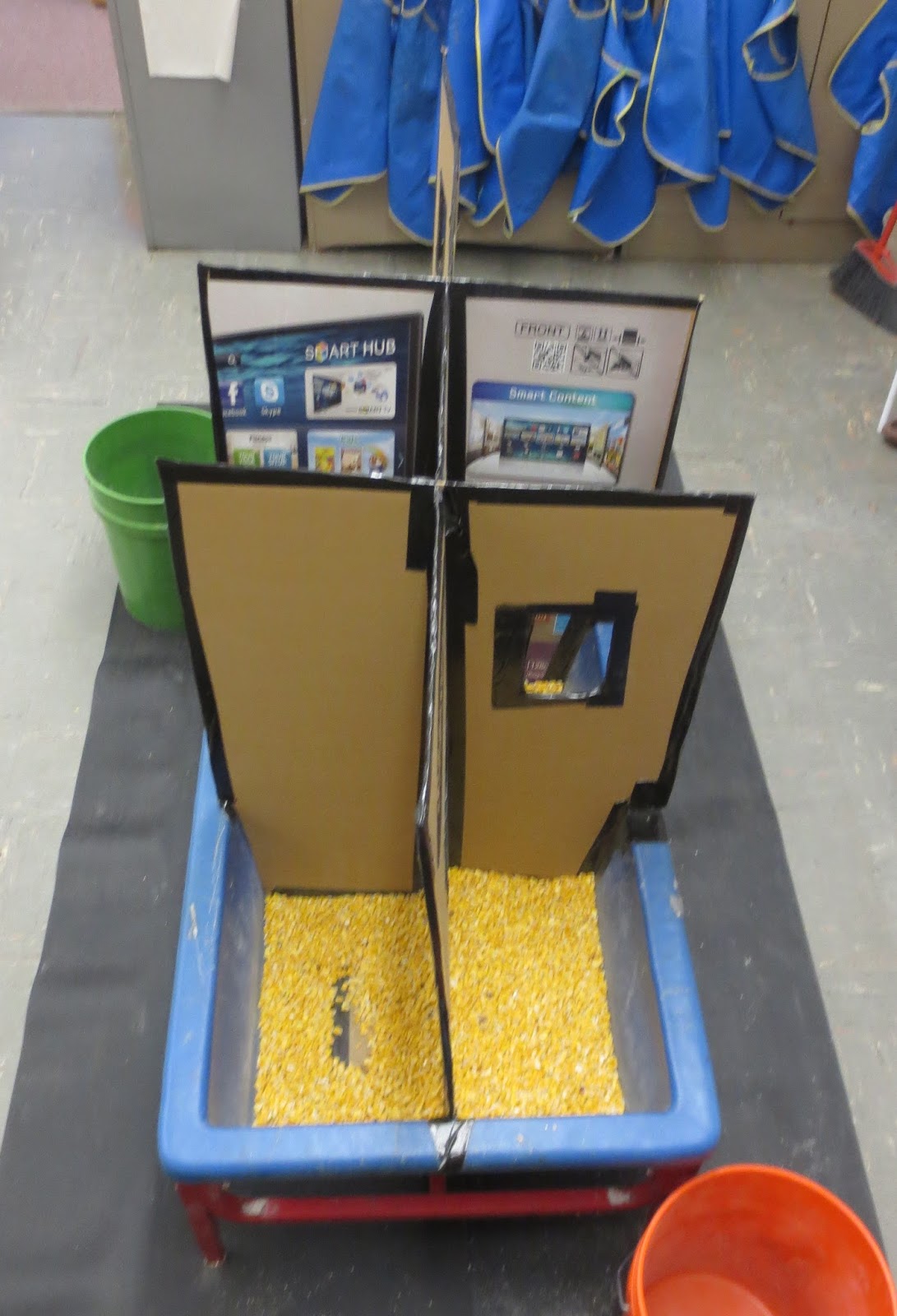
This year, I used a box from a large flat screen TV.  The box was big, which allowed me to cut one cardboard panel that was long enough to divide my two sensory tables lengthwise down the middle. 
I cut windows in the divider and then duct taped around them to lessen the prospect for paper cuts.  Someone I work with thought I had purposefully designed the windows to look cockeyed.  She liked the visual effect of the "crooked" windows.  The truth be told, I rarely measure; I just cut.  And the same goes for taping, too.

In addition to the one long panel, I had enough cardboard from the same box to make two flat cardboard panels for inserts to create spaces in the blue sensory table.  Here is a view from above.  It is easier to see how the inserted panels form the spaces across the width of the table.  These spaces are like little work cubicles.  And working in cubicles is a life skill, right?

Since I have written about this apparatus several times before,  I want to expound on only one type of social play that emerged this year that I have not seen before.  I don't know exactly what to call it but it involves ordering and making and paying for food through the windows.   What follows are three videos that illustrate this play.

In the first video, the girl looks through the window and asks the boy if he would like some food or something to eat.  The boy waits a long two seconds before he equivocally shakes his head "no."


Would you like to order something to eat? from Thomas Bedard on Vimeo.

I do not know why the boy doesn't accept the other child's invitation to play.  But that happens all the time in children's play.  And everybody just moves on to the next encounter.

In the second video, a boy is working feverishly filling his container.  He has already filled it to overflowing several times but there seems to be some urgency in his action.  When he is satisfied with his filling, he leans over the table and calls through the window to the other side: "More food."  I think he is letting someone know on the other side he has more food.  He moves to the adjacent cubicle and as he does he broadcasts that he needs an order.  As he moves to that adjacent space, the child in that space lets him in.  One more time he says he needs an order.  He proceeds to dump his container through the window saying: "More mac and cheese."


Mac and cheese from Thomas Bedard on Vimeo.

In this video even though one child is orchestrating the action, all the children are playing along.

In the third video, a mother is in the room playing with her daughter at the cardboard divider.  The daughter hands her corn through the window.  Her mother says she will pay her five dollars.  Mom reaches through the window and counts out five on her daughter's palm.

Five dollars from Thomas Bedard on Vimeo.

Without the cardboard divider, this sublime play episode with the mother and her daughter would never have happened.

Through observing children over the years at this apparatus, I know that children initiate new social interactions each and every time it is introduced.  What was different this time that spawned the "food through the window" play?  This play was widespread between other play partners and in other classes.  Why this play this year?  What experiences do the different children have with ordering or delivering food through windows?  What experiences in their life inform this play that make it meaningful to them?   

I have learned that I cannot always predict the scenarios that emerge in children's play.  And I cannot always know why those scenarios appear.  I suppose if I really wanted to know what to expect from children then I would have to teach differently.  But then I would just be fooling myself into thinking I can predict and know. 


Saturday, February 13, 2016

SOCIAL SKILLS

Once or twice a year, I put out Moon Sand.   When I put out Moon Sand, I like to set up a large wooden tray on which the children can work.  I start with two tables, the everyday blue table and the clear toddler table.
I place a large wooden tray on top of the toddler table.  To keep down the mess, I tape packing corners from an appliance box onto two sides and one end. 
The side that reaches over the blue table is left open.  That allows the children to easily move sand from the wooden tray into the blue table.

Besides the large wooden tray, I also set up a smaller wooden tray that spans the width of the blue table.
This picture highlights one of the salient features of Moon Sand.  It holds it shape so it can be molded.  That is also the reason I set up the trays with this type of sand because the sand forms take on more import when they sit above the table.  

In addition, the trays allow the children to work on a more comfortable level, much like the counter and workbench we use in the kitchen and workshop.  This more comfortable level, in turn, brings out the budding social skills of children.   For instance, in the picture above the children were making birthday cakes.  Once they were made, they decorated them.
And once they were decorated, the children had to decide which birthday cake was theirs.  And whose birthday was it anyway?  Watch.


Birthday cakes from Thomas Bedard on Vimeo.

Each child chose a birthday cake that was right in front of them  One child did change her mind because her friend pointed out that the figure on the other cake in front of her had longer hair.  Life would be so good if it were everybody's birthday and everybody was happy with the birthday cake they got.  (Did you notice no one picked the Ronald McDonald cake?)

Here is another example of those social skills in action.  Two boys were putting Moon Sand in a jello mold.  According to one of the boys, they cannot fill it to the top because they are making a little garage.  He qualified it a bit when he said they were making a little, big garage.  The other child keeps agreeing with him and adds: "...and then let's build a house."  


Building a garage from Thomas Bedard on Vimeo.

I have no idea how putting Moon Sand in a jello mold leads to making a garage.  But that is not important.  What is important is the natural way in which ideas flow back and forth in this give-and-take exchange between friends.

I write a lot about science and inquiry in relation to the apparatuses at the sensory table.  Just as important, though, are the opportunities they offer children to master the social skills such as negotiation and accommodation.  

On a lighter side, I want to leave you with a video with a touch of mirth that happened at the table this particular week.  In the video, the child in the orange tries to remove the Moon Sand that he has packed into a small plastic measuring cup.  He hits it on the tray.  But on the upswing of the second hit, it flies out.  It flies out right into the cup of the child on the opposite side of the table. (If you look closely at the setup picture for the video, you can see the Moon Sand in mid-flight over the other child's hand.)  When the child with the red cup looks for the Moon Sand, he can't find it and wonders where it went.  It happens so quickly that neither of the children notice what happened.  The child's face for whom the Moon Sand vanished is simply beguiling.  Enjoy.


Where did it go? from Thomas Bedard on Vimeo.